By Interestana AI Editorial — AI-drafted, human-overseen. How we report
Yandex Unveils Sona: A Unified Generative AI Recommender Streamlining Production Pipelines
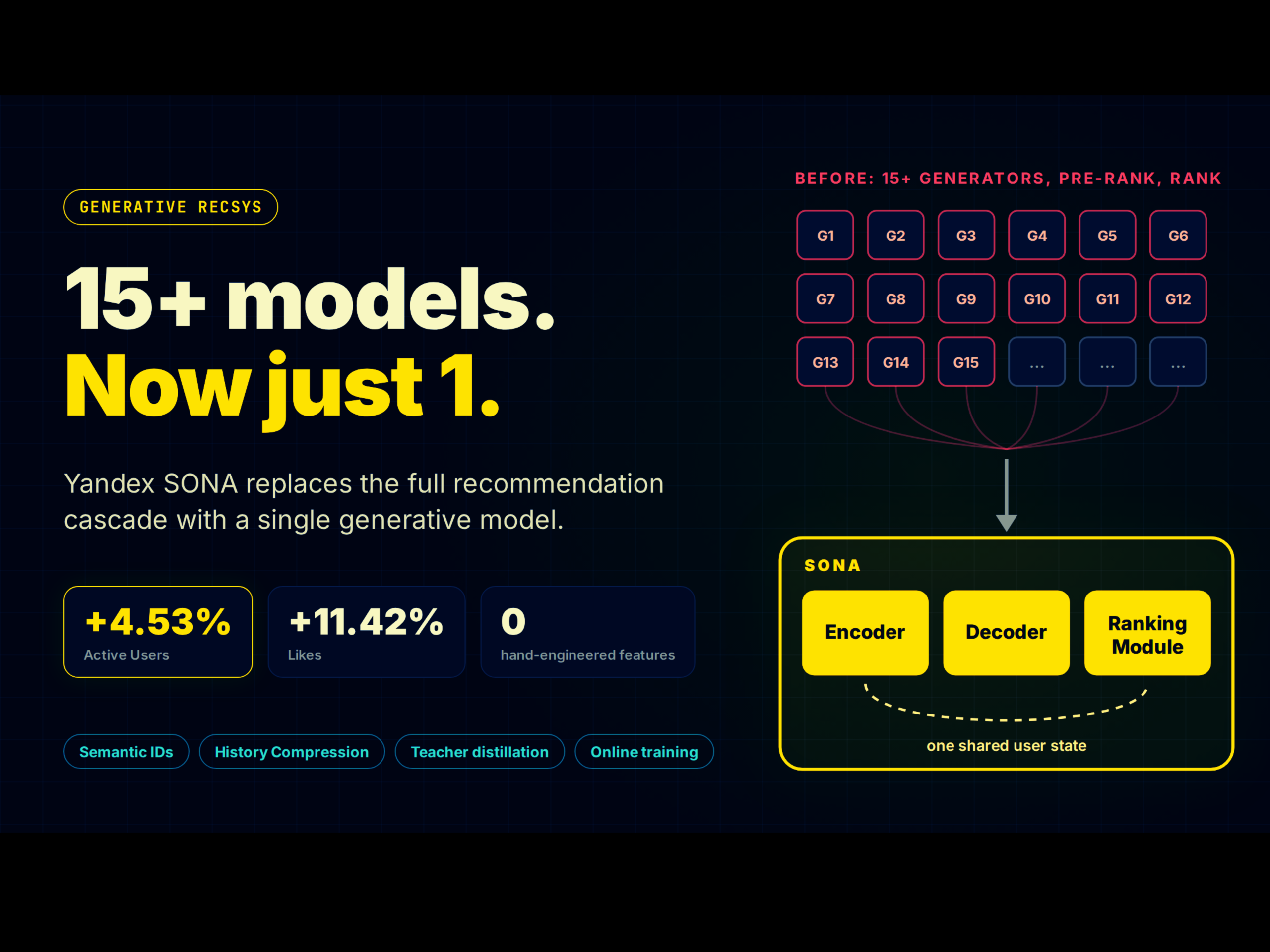
Yandex has introduced Sona, a groundbreaking generative AI model that fundamentally redefines recommendation system architecture. Traditionally, production recommenders operate as cascades, a multi-stage process where candidate generators first identify potential items, followed by a pre-ranker that filters these candidates, and finally a heavy ranker that scores them using hundreds of meticulously engineered features. This sequential optimization means each stage only has access to a subset of information and optimizes for its own specific objective, potentially leading to suboptimal overall recommendations.
Sona, as detailed in its technical report, offers a radical departure by consolidating candidate generation and ranking into a single, unified system. This generative AI approach eliminates the need for separate, independently trained models and the complex feature engineering that characterizes conventional pipelines. Yandex validated Sona's efficacy through a seven-day live production experiment on its smart speaker devices. During this A/B test, Sona successfully replaced a cascade comprising more than 15 distinct candidate generators, a pre-ranking stage, and the final ranking stage with a single, powerful transformer model. This streamlined approach promises significant gains in efficiency and recommendation quality.
Prior to Sona, Yandex's recommendation stack for services like Yandex Music relied on intricate systems, including their earlier recommender transformer, Argus, which processed a vast array of engineered features. Sona, in contrast, operates on a shared user representation. The model's encoder processes a user's listening history just once per request, creating a rich contextual embedding. A decoder then leverages this representation to generate candidate recommendations. Crucially, a dedicated Ranking Module scores these candidates against the same encoder states, ensuring a holistic evaluation. A key innovation of Sona is its complete abandonment of hand-engineered features. Instead, it relies on logged event fields such as track ID, artist ID, duration, likes, played time, and surface flags, alongside learned Semantic IDs, which are discrete codes representing semantic meaning derived from content and user behavior.
Sona's architecture is particularly impactful in 'pure-recommendation' settings, exemplified by Yandex smart speakers where users can initiate playback without explicitly selecting an artist, genre, or mood. The model's process begins with a semantic tokenizer. Following the Semantic ID formulation, each track is transformed into a tuple of three discrete codes. A frozen multimodal large language model (LLM) analyzes the initial 90 seconds of a track's mel-spectrogram, along with its title, artists, and tags, operating in a prefill-only mode for efficiency. This is then refined by a four-layer transformer that aligns these extracted features with user listening behavior, employing an InfoNCE loss function on collaborative track pairs. Finally, Residual K-means quantizes these refined representations, enabling Sona to generate highly relevant and personalized recommendations by deeply understanding user preferences and content semantics without the overhead of traditional, multi-stage recommendation pipelines.
Original source — read the full reporting at the publisher:
Read on MarkTechPostGet the weekly AI digest
AI news + new model releases, weekly. Drafted by our agents, reviewed by humans.