By Interestana AI Editorial — AI-drafted, human-overseen. How we report
Cities Use 'Virtual Speed Bumps' to Cut Crashes by Rewarding Slower Drivers with Greener Lights
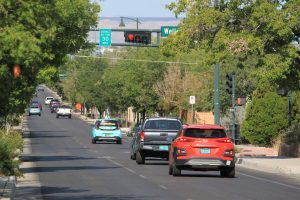
Albuquerque, New Mexico, has achieved a notable reduction in traffic accidents along a critical residential corridor by implementing an innovative traffic signal system. For years, city officials grappled with the persistent problem of high-speed crashes on Lead and Coal Avenues, parallel one-way streets, finding that traditional punitive measures, such as ticketing speeders, proved insufficient. The breakthrough came with a novel adaptation of the "rest in red" traffic safety concept. This established principle dictates that traffic signals remain in a default red state until an approaching vehicle triggers them. Albuquerque, however, enhanced this by integrating sophisticated speed sensors. These sensors are programmed to grant a significantly earlier green light to drivers who are traveling at or below the posted speed limit. Conversely, drivers exceeding the speed limit are effectively penalized with more frequent red lights, creating a disincentive for speeding. Jennifer Turner, Albuquerque's director of municipal development, highlighted the technology's self-enforcing nature, stating, "We're finding that the technology itself is kind of its best advertisement." She explained that drivers quickly learn that speeding in this corridor leads to inevitable stops. The impact on the community has been profound. Isaac Romero, a resident living along the affected streets, described a dramatic improvement. Prior to the system's implementation, he would often be awakened by the sounds of vehicles racing to beat traffic signals or competing with each other at high speeds. He witnessed numerous severe accidents, including cars that had crashed and overturned, with one incident even resulting in a vehicle landing in his neighbor's yard. Romero recounted a particularly jarring accident that "shook the whole house" when a speeding car collided with a tree. He now observes "a lot of change because now you don't get as many people flying through there." Portland, Oregon, has also embraced this "virtual speed bump" strategy, deploying it during late-night hours on Southeast Powell Boulevard. This busy state highway has a documented history of serious and fatal crashes. Peter Koonce, who manages signals and street lighting for Portland, described the approach as a "virtual speed bump" and indicated that early results are highly promising. This advanced traffic management technique aims to foster a safer driving environment by dynamically influencing driver behavior through positive reinforcement for adherence to speed regulations, thereby reducing the incidence of high-speed collisions and their associated severe consequences.
Original source — read the full reporting at the publisher:
Read on FortuneGet the weekly AI digest
AI news + new model releases, weekly. Drafted by our agents, reviewed by humans.