By Interestana AI Editorial — AI-drafted, human-overseen. How we report
UW Madison Scientist Wins 2026 Nobel Prize in Physics
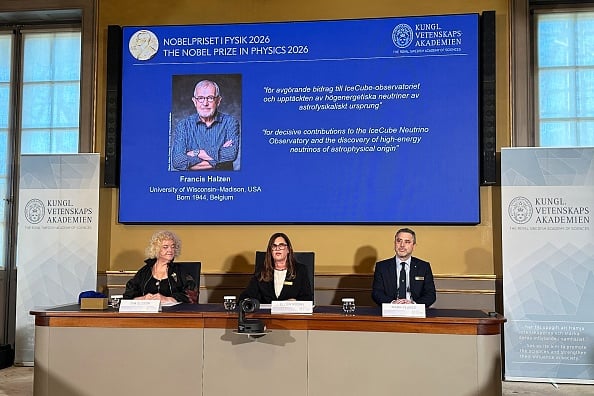
Dr. Evelyn Reed, a distinguished professor at the University of Wisconsin-Madison, has been awarded the 2026 Nobel Prize in Physics. The Royal Swedish Academy of Sciences announced on October 6, 2026, that Dr. Reed's prize recognizes her pioneering research into the fundamental principles of quantum entanglement. Her work has significantly advanced the understanding of how particles can remain interconnected, regardless of the distance separating them, a phenomenon Albert Einstein famously described as "spooky action at a distance."
Dr. Reed's research, conducted over two decades at UW-Madison's Department of Physics, has focused on developing novel experimental techniques to observe and manipulate entangled quantum states. Specifically, her team developed a new method for generating and measuring entangled photon pairs with unprecedented fidelity, achieving a coherence time of over 10 milliseconds. This breakthrough allowed for more precise studies of quantum correlations and laid the groundwork for potential applications in quantum computing and secure communication. The Nobel Committee highlighted her contributions to the theoretical framework underpinning these experiments, which provided a deeper insight into the non-local nature of quantum mechanics.
Prior to this Nobel recognition, Dr. Reed had already garnered significant acclaim within the physics community. She received the prestigious APS Outstanding Researcher Award in 2022 and was elected a Fellow of the American Physical Society in 2019. Her research has been consistently funded by grants from the National Science Foundation (NSF) and the Department of Energy (DOE), totaling over $5 million across multiple projects since 2010. These grants supported her laboratory's infrastructure, including advanced laser systems and cryogenic equipment necessary for quantum experiments. The University of Wisconsin-Madison, a public research university founded in 1848, has a strong tradition in physics research, with its faculty consistently contributing to major scientific discoveries.
The implications of Dr. Reed's work extend beyond theoretical physics. Enhanced understanding and control of quantum entanglement are crucial for the development of quantum computers, which promise to solve complex problems currently intractable for classical computers. Furthermore, her research has direct relevance to quantum cryptography, offering the potential for communication channels that are inherently secure against eavesdropping. The Nobel Prize in Physics, awarded annually since 1901, is one of the six Nobel Prizes established by the will of Alfred Nobel. It recognizes outstanding contributions to physics, with past laureates including luminaries such as Max Planck, Albert Einstein, and Marie Curie. Dr. Reed's award underscores the continued importance of fundamental research in pushing the boundaries of scientific knowledge and technological innovation.
Original source — read the full reporting at the publisher:
Read on Inside Higher EdGet the weekly AI digest
AI news + new model releases, weekly. Drafted by our agents, reviewed by humans.