By Interestana AI Editorial — AI-drafted, human-overseen. How we report
World's Largest Solar Telescope Captures Sun's Kelvin-Helmholtz Instabilities
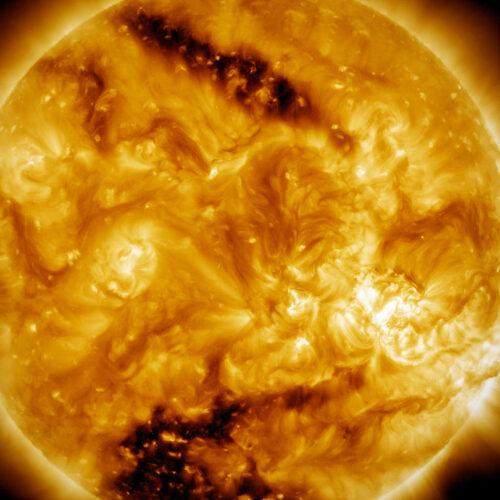
The Daniel K. Inouye Solar Telescope, the world's largest solar observatory, has provided the first direct visual confirmation of Kelvin-Helmholtz instabilities on the Sun's surface. This phenomenon, a fundamental principle of fluid dynamics first described by Lord Kelvin and Hermann von Helmholtz in the 1860s, occurs when two fluids move at different speeds along a boundary, causing it to buckle, curl, and roll into vortexes. Scientists have long theorized that these instabilities, responsible for phenomena like wind-driven ripples on water and the formation of wave clouds, must also be present in the Sun's plasma. However, the small scale of these plasma vortexes, below the resolution capabilities of telescopes with mirrors smaller than 2 meters, had prevented their direct observation until now.
The breakthrough was achieved by a research team led by David Kuridze and Friedrich Wöger of the National Solar Observatory. Their study, published recently, proposes that the ubiquitous presence of these Kelvin-Helmholtz instabilities on the Sun could significantly alter current understandings of how heat, mass, and magnetic energy are transported through the Sun's atmosphere. The Daniel K. Inouye Solar Telescope, operated by the US National Science Foundation and located in Hawaii, boasts a 4-meter mirror, making it capable of resolving these previously hidden solar features. The telescope officially entered its operational phase in November 2021, enabling this groundbreaking observation.
Kelvin-Helmholtz instabilities are a common occurrence in astrophysical environments, playing a role in the formation of nebulae and the dynamics of planetary atmospheres. On Earth, they are observed in atmospheric and oceanic phenomena. The confirmation of their presence on the Sun opens new avenues for solar physics research, potentially leading to more accurate models of solar activity, solar flares, and the solar wind. Understanding these small-scale turbulent structures is crucial for comprehending the Sun's complex magnetic field and its influence on the heliosphere, which extends far beyond Earth and affects space weather.
The implications of this discovery extend to space weather forecasting, which is vital for protecting satellites, power grids, and astronauts from the effects of solar storms. By better understanding the fundamental processes driving energy transfer within the Sun's atmosphere, scientists can improve predictions of these events. The Daniel K. Inouye Solar Telescope's advanced capabilities are expected to yield further insights into the Sun's behavior, solidifying its role as a pivotal instrument in solar research.
Original source — read the full reporting at the publisher:
Read on Ars TechnicaGet the weekly AI digest
AI news + new model releases, weekly. Drafted by our agents, reviewed by humans.