By Interestana AI Editorial — AI-drafted, human-overseen. How we report
Florida HOAs Control Nearly Half of State Residents
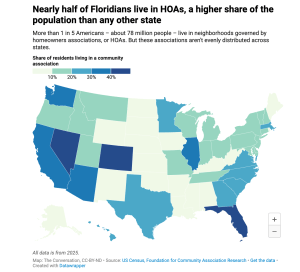
A sociologist's research highlights the pervasive influence of Homeowners Associations (HOAs) in Florida, where nearly half of the state's residents live in communities governed by these entities. The study, conducted between 2017 and 2020, involved interviews with 47 residents of a central Florida community, all identifying as Latino, Caribbean, or Black. These residents consistently reported feeling unwelcome and receiving messages from HOA officials that they did not belong, despite being unable to afford moving due to rising housing prices. The sociologist posits that HOAs can function as "racialized organizations," a concept describing entities that, even if appearing neutral, can perpetuate inequality and diminish the agency of racialized groups, defined as those perceived as different from the white majority. Coretta, a pseudonym used to protect her identity, shared her experience as a Black mother of three with a real estate background, living in the community for over 20 years. She expressed a sense of apathy replacing her anger, suggesting that the original developers may not have intended for the community to have a heavily Hispanic population and might have been attempting to exclude residents of a certain economic class. The research indicates that this phenomenon is not unique to Florida. Across the United States, HOAs govern 80% of new single-family homes in subdivisions and 60% of all new single-family homes, suggesting that residents like Coretta would likely encounter similar governance structures even if they relocated. The sociologist's findings underscore the potential for HOAs to create and maintain social and economic inequalities, particularly for minority groups, by subtly or overtly signaling exclusion and limiting residents' ability to challenge these dynamics. The study's focus on residents of color in a predominantly Hispanic community in central Florida provides a specific case study for understanding these broader patterns of HOA governance and its impact on community demographics and resident experiences. The research implies that the perceived neutrality of HOA rules can mask underlying biases that disproportionately affect marginalized populations, leading to a sense of disenfranchisement and economic precarity.
Original source — read the full reporting at the publisher:
Read on FortuneGet the weekly AI digest
AI news + new model releases, weekly. Drafted by our agents, reviewed by humans.