By Interestana AI Editorial — AI-drafted, human-overseen. How we report
Classroom Tech Threatens 'Fully Human' Skills Vital for AI Era, Education Experts Warn
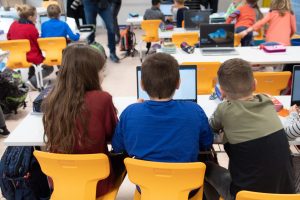
As the new academic year commences, a significant debate is unfolding regarding the pervasive integration of digital devices in educational settings, with numerous school districts re-evaluating their technological strategies. This discussion gains urgency in light of declining standardized test scores in fundamental subjects like mathematics and reading, a trend observed in many districts that have transitioned from traditional textbooks to digital screens. However, the impact of computers and tablets on student development extends far beyond these core academic areas, according to education experts.
Sarah Schneider Kavanagh, a professor at the University of Pennsylvania Graduate School of Education, and Katie A. Danielson, a professor at the University of Portland School of Education, articulated these concerns in a recent Washington Post op-ed. They contend that elementary education historically provided more than just foundational literacy and numeracy, often referred to as the "three R's" (reading, writing, and arithmetic). Crucially, these early educational experiences fostered vital interpersonal and cognitive skills. Children learned the art of active listening, waiting for others to articulate their thoughts before contributing their own, a practice essential for respectful discourse. They also developed skills in negotiating disagreements, a cornerstone of collaborative problem-solving, and learned to clearly explain their reasoning and thought processes. These nuanced person-to-person interactions are fundamental to cognitive maturation, as opposed to the passive reception of information.
While acknowledging the potential benefits of individualized instruction facilitated by classroom computers and adaptive learning software, Kavanagh and Danielson caution against significant trade-offs. They highlight a scenario where students might passively click through digital math lessons, missing the invaluable opportunity to engage with diverse problem-solving approaches demonstrated by their peers. This collective learning, they argue, is particularly critical in the burgeoning era of artificial intelligence. As AI systems become more sophisticated, distinctly human skills such as sustained attention, genuine curiosity, sound judgment, empathy, and robust collaboration are poised to become even more valuable and sought-after. These are the attributes that differentiate human capability from algorithmic processing.
The professors strongly assert that educational institutions should not aim to mirror the digital environment that children already extensively inhabit outside of school hours. Instead, they advocate for learning spaces intentionally designed to cultivate different objectives. This includes prioritizing activities that foster genuine conversation and critical thinking over passive consumption of digital content, and emphasizing collaborative projects rather than purely personalized, isolated learning experiences. This pedagogical approach, they emphasize, is not an act of resisting technological progress. Rather, it is a proactive strategy to equip children with the essential human capacities and resilience needed to thrive and remain "fully human" in an increasingly digitized future.
Original source — read the full reporting at the publisher:
Read on FortuneGet the weekly AI digest
AI news + new model releases, weekly. Drafted by our agents, reviewed by humans.