By Interestana AI Editorial — AI-drafted, human-overseen. How we report
Python Script Automates Keyword Clustering for SEO
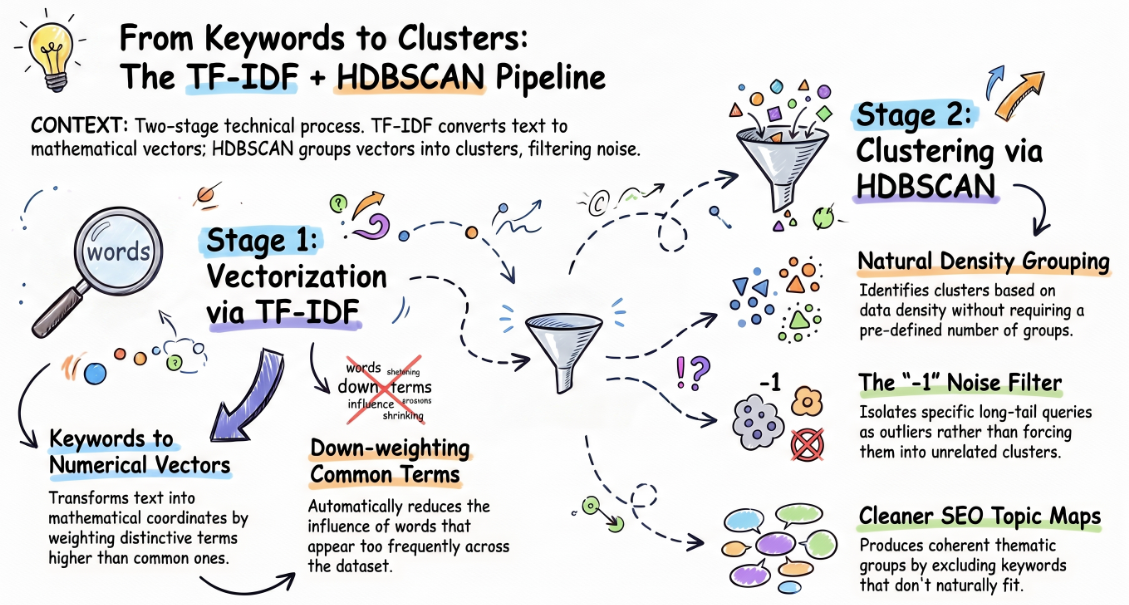
A refactored Python script has been developed to automate the process of keyword clustering, a crucial task in Search Engine Optimization (SEO) that traditionally involves manual effort and struggles with semantic nuances. This script addresses the scalability issues of manual keyword grouping and the limitations of rule-based methods that fail to identify semantically related phrases lacking shared words. The framework employs TF-IDF (Term Frequency-Inverse Document Frequency) vectorization to generate numerical feature vectors for keywords. These vectors are then processed by HDBSCAN, a density-based clustering algorithm, to group semantically similar queries into coherent topics. The script is available for use, aiming to streamline content strategy and enhance topical authority.
Keyword clustering serves as a foundational step for topic generation in SEO. Instead of briefing content writers with extensive lists of individual keywords, clustering allows for the aggregation of semantically related search queries into distinct topics. This approach facilitates the creation of content that effectively addresses a broader spectrum of search intent. The outcome is a structured set of topics designed to bolster semantic relationships, establish topical authority, improve internal linking strategies, and increase visibility across a range of related search terms. The process presents two primary challenges: the preprocessing of raw keyword data and the actual clustering of identified topics.
Data preprocessing is essential because SEO keyword exports, particularly those originating from internal databases, often contain significant noise. Manual removal of stopwords and non-ASCII characters is impractical for large datasets, necessitating automated data cleaning at scale. Python offers a flexible solution through its ability to construct a data processing pipeline capable of cleaning, normalizing, and transforming extensive keyword datasets with minimal manual intervention. This automation ensures data quality and consistency, which are vital for accurate clustering.
For the clustering phase, analyzing keyword data typically does not reveal the exact number of existing topical groups beforehand. This characteristic makes algorithms like k-means, which require a pre-specified number of clusters, less suitable for the task. The combination of TF-IDF vectorization and HDBSCAN proves to be a highly effective approach. TF-IDF transforms each keyword into a numerical representation by assigning weights based on term frequency within a document and inverse document frequency across the corpus. This numerical representation captures the semantic essence of the keywords, allowing HDBSCAN to identify dense regions of similar keywords, thereby forming meaningful clusters that represent distinct topics. This method overcomes the limitation of needing to know the number of clusters in advance, adapting to the inherent structure of the data.
Original source — read the full reporting at the publisher:
Read on Search Engine LandGet the weekly AI digest
AI news + new model releases, weekly. Drafted by our agents, reviewed by humans.