By Interestana AI Editorial — AI-drafted, human-overseen. How we report
Google AI Unveils EnvHarness for Adaptive Agent Training
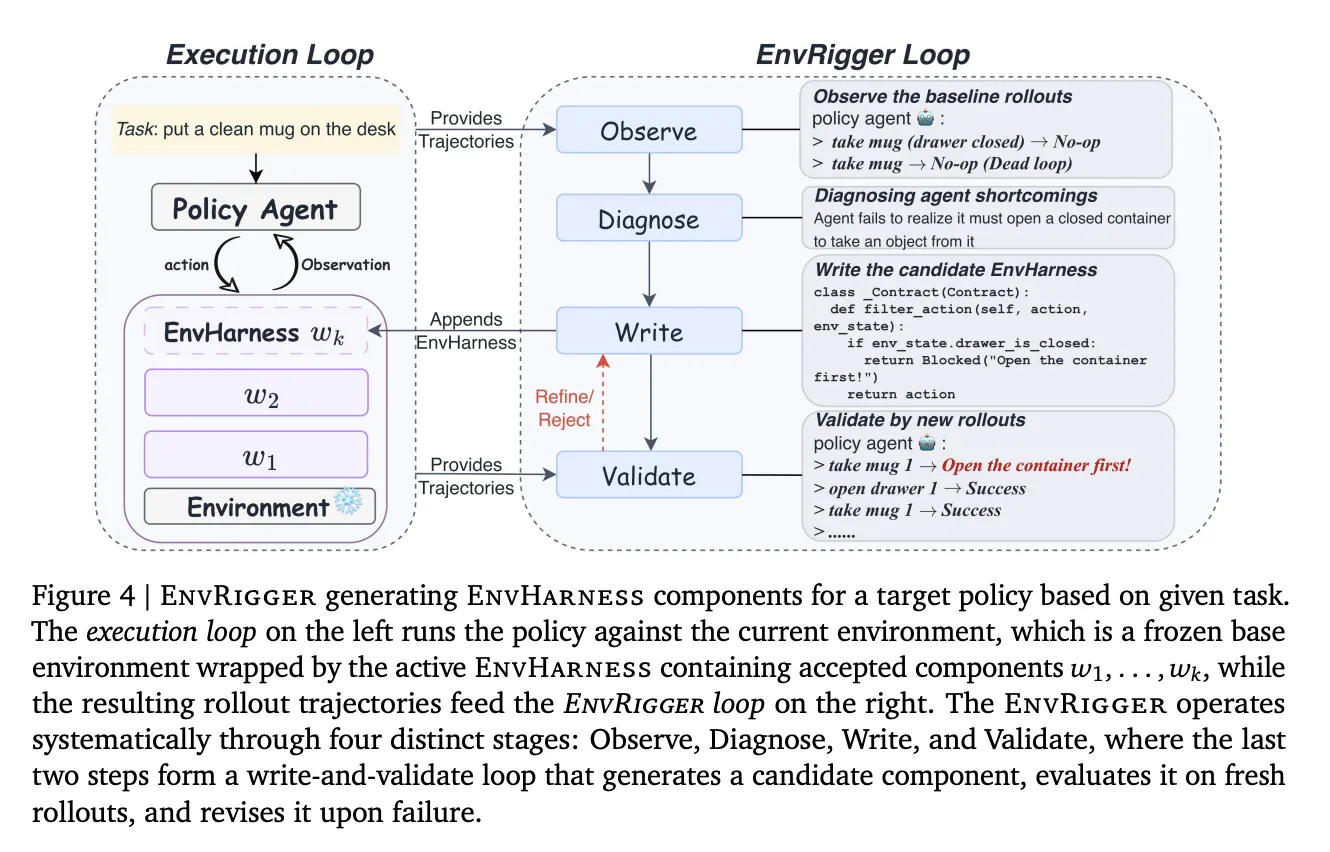
Google Cloud AI Research, in collaboration with Washington University in St. Louis and UNC Chapel Hill, has introduced EnvHarness, a novel programmable layer designed to enhance the training of AI agents. This innovation transforms static agent benchmarks into dynamic, adaptive environments that evolve alongside the learning policies. Traditionally, LLM agents have relied on interactive environments for training, but these environments have been static, meaning they respond identically regardless of the agent's actions or progress. This limitation prevents them from effectively targeting an agent's weaknesses and offers no further learning opportunities once an agent masters them.
EnvHarness addresses this challenge by inverting the conventional approach. Instead of generating entirely new environments, it wraps existing ones with plug-in components. These components operate seamlessly through the standard reset() and step() interfaces, modifying aspects such as episode starting points, agent capabilities, and observable information without altering the core simulator, tasks, or human-defined verification processes. A specialized LLM designer, termed EnvRigger, automatically generates these wrappers by analyzing flaws identified in the agent's own performance rollouts.
The effectiveness of EnvHarness has been demonstrated across five benchmarks spanning four distinct domains. Agents trained using this adaptive method showed significant improvements, gaining up to 9.0 points on previously unseen tasks. Furthermore, these agents achieved this enhanced performance with a reduction of 9.8% in execution steps, indicating greater efficiency. The system is designed for immediate deployment by users already operating an agent evaluation loop. EnvHarness is publicly available as an Apache-2.0 licensed Python package, complete with reproduction drivers for six environments, facilitating its integration and testing.
Implementing EnvHarness requires adherence to a single interface, which includes methods such as reset(), step(), observe(), evaluate(), get_env_state(), save_state(), and from_state(). Once this interface is implemented, downstream components remain unaffected. A key prerequisite for using EnvHarness is the availability of a resettable environment, which excludes real-time user accounts and physical robotic systems from its direct application. The research highlights a shift in LLM agent training, moving from static, text-based learning to more dynamic, interactive environmental engagement, thereby fostering more robust and efficient AI development.
Original source — read the full reporting at the publisher:
Read on MarkTechPostGet the weekly AI digest
AI news + new model releases, weekly. Drafted by our agents, reviewed by humans.