By Interestana AI Editorial — AI-drafted, human-overseen. How we report
Bank of America and S&P Global Discuss AI Adoption and Risks
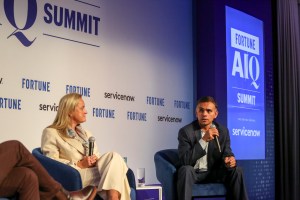
Bank of America's Chief Technology and Information Officer, Hari Gopalkrishnan, highlighted a common pitfall in artificial intelligence adoption: treating AI as a universal solution rather than a tool for specific problems. Speaking at Fortune's AIQ Summit in New York, Gopalkrishnan emphasized that "deterministic models do a plenty good job" for many tasks, suggesting that organizations should first explore simpler, established methods before resorting to AI. He was joined by Sally Moore, S&P Global's Chief Client Officer and co-head of Kensho Data & Platforms, with Fortune Editorial Director Andrew Nusca moderating the discussion.
Gopalkrishnan elaborated on Bank of America's approach, stating that the bank prioritizes understanding client needs and conducting a "process inventory" of existing workflows before considering AI implementation. He noted that the bank frequently opts against AI, finding that traditional solutions like mobile applications or real-time decision rules are often more appropriate and effective. Every proposed AI project undergoes a rigorous review process, evaluating 16 "pillars" of risk, which include considerations for privacy, potential bias, workforce impact, and intellectual property. Gopalkrishnan provided an example of this caution, stating, "We’re not going to implement a chatbot that only answers to certain accents." The bank has a history with AI, having utilized fraud detection models for over a decade. Its virtual assistant, Erica, has processed an impressive 3.6 billion transactions, a volume that Gopalkrishnan estimates would have required an additional 11,000 employees to handle without the AI's assistance. A March press release from the bank further quantified Erica's impact, reporting over 3.2 billion client interactions.
Despite this measured approach, Bank of America is significantly investing in AI. CEO Brian Moynihan announced in September that the bank was already utilizing approximately 140 AI applications, which incurred $400 million in costs but generated $800 million in benefits. The AI expense budget is slated to double in the upcoming year. Gopalkrishnan explained that this substantial spending is strategically managed, with the bank maintaining a "model-agnostic" stance. An internal orchestration layer, named "Orchestra," is employed to route tasks to appropriate AI models. Simple classification tasks are directed to approved open-weight models running on the bank's own Graphics Processing Units (GPUs), while more complex reasoning tasks are handled by proprietary models. This layered approach also contributes to controlling token costs, a significant consideration in AI operations. In the wealth management sector, advisors are now reportedly able to prepare for client meetings in mere "seconds and minutes," indicating a substantial efficiency gain driven by AI integration. S&P Global, through its Kensho Data & Platforms division, is also actively involved in developing and deploying AI solutions, particularly for financial data analysis and insights, aiming to enhance client services and operational efficiency within the financial industry.
Original source — read the full reporting at the publisher:
Read on FortuneGet the weekly AI digest
AI news + new model releases, weekly. Drafted by our agents, reviewed by humans.