By Interestana AI Editorial — AI-drafted, human-overseen. How we report
Why More Traffic Won’t Fix Your Growth Problem (But This Will)
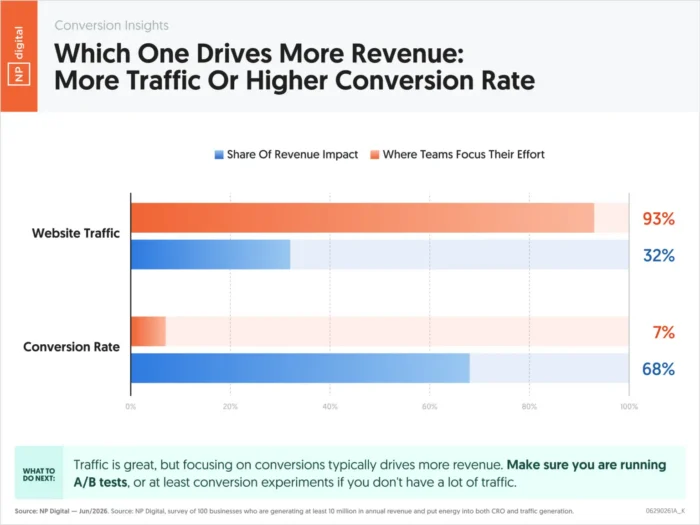
Conversion rate optimization (CRO) presents a significantly more impactful avenue for revenue growth compared to an exclusive focus on increasing website traffic, as evidenced by research conducted by NP Digital. This research, which surveyed businesses generating at least $10 million in annual revenue and investing in both CRO and traffic generation, revealed a stark disparity in their impact. Conversion rate was found to account for a substantial 68 percent of revenue impact, while website traffic contributed a comparatively smaller 32 percent. Despite this clear data, a striking 93 percent of marketing and growth teams continue to allocate the majority of their efforts towards driving more traffic, with a mere 7 percent prioritizing conversion rate improvements. This persistent overemphasis on traffic acquisition often stems from a fundamental misconception: the belief that increased impressions, sessions, or leads automatically translate into higher revenue. However, NP Digital's research critically debunks three common and detrimental assumptions that consistently hinder growth teams. Firstly, more impressions do not inherently guarantee more clicks; users may see an ad or listing but not engage. Secondly, more sessions do not ensure more conversions; visitors may browse a website but not complete a desired action. Finally, more leads do not necessarily lead to more revenue; a lead may not be qualified or may not ultimately purchase. Each step in this chain represents a potential leak point within the customer journey. Funneling more traffic into a flawed system merely amplifies existing inefficiencies and wastes marketing spend. Adding to this challenge, the cost of acquiring traffic is on a continuous upward trajectory. The cost per click (CPC) is steadily rising across all major advertising platforms, making the pursuit of more traffic an increasingly expensive and less efficient strategy. The core issue for the majority of companies is not a fundamental lack of traffic, but rather an unidentified or unaddressed conversion problem. This gap in understanding and execution is precisely where competitors are actively gaining ground by optimizing their existing visitor base. Conversion loss typically originates from four primary areas: messaging that fails to resonate with the target audience, friction within the user experience that impedes progress, a lack of trust that deters action, and an overall poor user experience that frustrates visitors. Addressing these underlying issues requires a systematic and data-driven approach to CRO, moving beyond reactive, aesthetically driven changes that often have minimal impact. A structured four-step framework—research, prioritize, test, and scale—enables teams to methodically identify, implement, and refine improvements. The fundamental principle driving conversions is the removal of uncertainty for the potential customer, rather than simply making a page visually appealing. When uncertainty is reduced through clear messaging, seamless user journeys, and established trust, users are far more likely to convert, leading to tangible and sustainable revenue gains. This strategic shift from a sole focus on traffic acquisition to a balanced approach prioritizing conversion optimization is therefore crucial for achieving sustainable business growth in today's highly competitive digital landscape.
Original source — read the full reporting at the publisher:
Read on Neil PatelGet the weekly AI digest
AI news + new model releases, weekly. Drafted by our agents, reviewed by humans.