By Interestana AI Editorial — AI-drafted, human-overseen. How we report
SpaceX Rocket's Lunar Collision: An Accidental Boon for Lunar Science
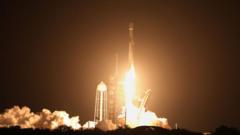
A SpaceX Falcon 9 rocket's upper stage, designated object 2015-007B, launched in 2015 as part of NASA's Deep Space Climate Observatory (DSCOVR) mission, is on an unguided trajectory towards the Moon. Its impact is anticipated in early March 2022. Initially considered mere space debris, this impending collision has been re-evaluated by astronomers as a potentially valuable scientific opportunity. The demise of this human-made object will create a crater on the lunar surface, offering a unique chance to analyze the composition of the Moon's regolith and subsurface layers. Astronomers anticipate that the impact will eject material from beneath the lunar surface, providing a sample that can be studied remotely using telescopes. This accidental collision presents a unique, albeit uncontrolled, experiment that could yield data unobtainable through traditional lunar missions. The specific Falcon 9 upper stage involved is a testament to the increasing volume of hardware in Earth orbit and beyond. Its trajectory has been meticulously tracked by observatories, and the predicted impact zone is on the far side of the Moon, an area less studied due to communication challenges. The scientific community, particularly those focused on lunar geology and planetary science, is actively preparing to observe the event and its aftermath. The potential for new insights into the Moon's geological history and composition is significant, as the impact will expose material that has been shielded from solar radiation and cosmic rays for billions of years. This event underscores the growing challenge of managing space debris, a consequence of decades of space exploration by various nations and private entities, even as it presents unexpected scientific benefits. The Moon, a celestial body that has been subjected to countless natural impacts over its approximately 4.5-billion-year history, will now experience a human-made collision offering a novel point of study. The data gathered could help refine models of lunar formation and evolution, and potentially inform future human exploration efforts by providing a better understanding of lunar resources and hazards. The scientific community is particularly interested in the spectral analysis of the ejected material, which could reveal the presence of specific minerals or volatile compounds, offering clues about the Moon's internal structure and its formation alongside Earth. This unexpected lunar rendezvous highlights the dual nature of space exploration: the inherent risks associated with the accumulation of space debris and the serendipitous discoveries that can arise from unforeseen events, turning a potential hazard into a scientific windfall.
Original source — read the full reporting at the publisher:
Read on BBC World NewsGet the weekly AI digest
AI news + new model releases, weekly. Drafted by our agents, reviewed by humans.