By Interestana AI Editorial — AI-drafted, human-overseen. How we report
Neutrino Identity Swaps May Explain Supernova Mysteries
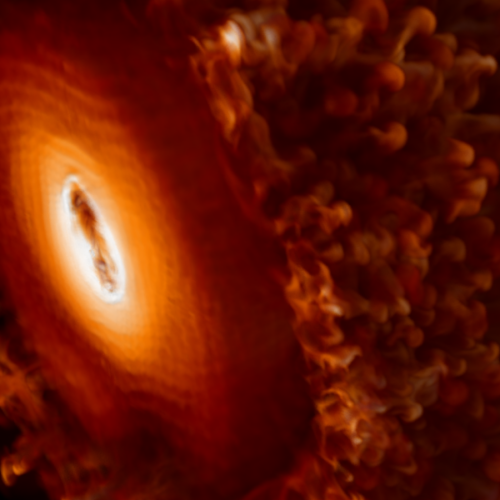
A recent paper published in Physical Review D proposes that the phenomenon of neutrinos swapping identities, known as flavor oscillation, could provide a crucial missing piece in understanding core-collapse supernovae. Current astrophysical models of these stellar explosions, which occur when massive stars exhaust their nuclear fuel and their cores collapse under gravity, have remained largely unchanged for decades. These models describe the process where the core collapses into a neutron star or black hole, and the resulting energy release expels the star's outer layers. However, observational data from supernovae has consistently shown discrepancies that suggest these models are incomplete.
Neutrinos are fundamental particles that play a significant role in the energy transport and dynamics of supernovae. They are produced in vast quantities during the core collapse and are weakly interacting, meaning they can escape the dense stellar interior and carry away a substantial amount of energy. The standard supernova model incorporates neutrino interactions, but it has historically overlooked or underestimated the impact of neutrino flavor oscillation. This is the process by which a neutrino created with a specific flavor (electron neutrino, muon neutrino, or tau neutrino) can transform into another flavor as it travels.
The implications of neutrino flavor oscillation within the extreme conditions of a supernova are profound. The energy spectrum and interaction rates of neutrinos are dependent on their flavor. If neutrinos are constantly changing flavors, their collective behavior and the way they interact with the surrounding stellar matter would be significantly altered. This could affect the efficiency of energy transport from the core to the outer layers, potentially influencing whether a core collapse event results in a visible supernova explosion or a direct collapse into a black hole, a question that remains a subject of theoretical debate. The paper in Physical Review D aims to quantify these effects and demonstrate how they could reconcile the observed supernova statistics with theoretical predictions.
This research highlights a critical area of uncertainty in astrophysics. While the basic framework of stellar evolution and supernova mechanisms is well-established, the precise details of the explosion process, particularly the role of neutrinos, are still being refined. The ability of neutrinos to oscillate adds a layer of complexity that may be essential for a complete picture. By incorporating flavor-changing neutrinos, scientists hope to develop more accurate simulations that can better match observational data, thereby deepening our understanding of the life and death of massive stars and the cosmic origins of heavy elements forged in these cataclysmic events.
Original source — read the full reporting at the publisher:
Read on Ars TechnicaGet the weekly AI digest
AI news + new model releases, weekly. Drafted by our agents, reviewed by humans.