By Interestana AI Editorial — AI-drafted, human-overseen. How we report
Waymo CEO: Camera-Only Driving Hits Safety Ceiling
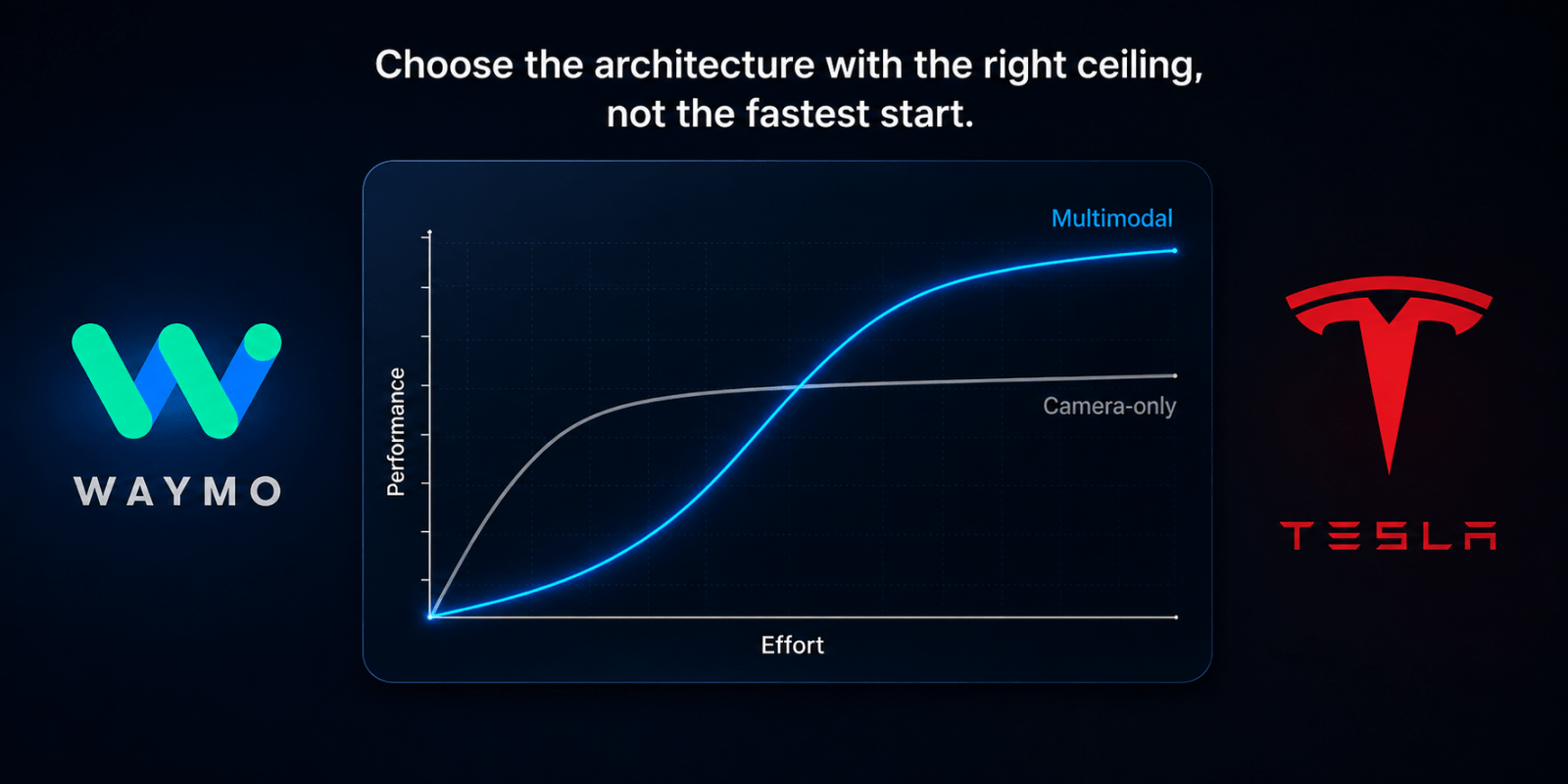
Waymo co-CEO Dmitri Dolgov has articulated a detailed technical argument explaining why relying solely on cameras is insufficient for achieving full self-driving autonomy. Dolgov asserted that camera-only systems encounter a critical limitation he termed "weak sensing," which imposes a safety ceiling that prevents these systems from reaching superhuman levels of performance. While Dolgov did not explicitly name Tesla, his remarks are widely interpreted as a direct critique of the automotive company's strategy, which heavily emphasizes a camera-centric approach to its autonomous driving technology. This technical explanation from Waymo's leadership provides a clear counterpoint to the prevailing camera-only philosophy in the autonomous vehicle industry.
Dolgov's explanation centers on the inherent limitations of visual sensors. Cameras, while capable of capturing detailed visual information, are susceptible to environmental conditions such as poor lighting, adverse weather (rain, snow, fog), and direct glare from sunlight or headlights. These conditions can significantly degrade the quality and reliability of the visual data, making it difficult for AI systems to accurately perceive and interpret the driving environment. In contrast, Waymo's approach integrates multiple sensor modalities, including lidar, radar, and cameras. Lidar uses lasers to create a precise 3D map of the surroundings, unaffected by light conditions, while radar can penetrate fog and rain to detect objects and their velocities. This sensor fusion strategy, according to Dolgov, provides a more robust and comprehensive understanding of the environment, crucial for safe navigation in complex scenarios.
The "weak sensing" concept highlights that even with advanced AI algorithms, the quality of input data fundamentally limits the system's capabilities. Dolgov suggested that camera-only systems reach a point where further improvements in software or processing power cannot overcome the fundamental limitations of the sensors themselves. This plateau in performance, he argued, occurs long before the system can be considered truly autonomous or capable of outperforming human drivers consistently across all conditions. Waymo's own development trajectory, which has involved extensive testing and iteration with a diverse sensor suite, underscores their belief in the necessity of redundancy and complementary sensing technologies.
Waymo, a subsidiary of Alphabet Inc., has been a pioneer in autonomous vehicle technology, with its self-driving cars accumulating millions of miles of real-world driving experience. The company's operational focus has been on developing a fully autonomous ride-hailing service, emphasizing safety and reliability. Dolgov's technical exposition serves to reinforce Waymo's long-standing commitment to a multi-sensor approach, positioning it as a more viable path to widespread autonomous driving deployment compared to strategies that rely on a single primary sensor type. The debate over sensor technology is a critical juncture for the future of autonomous vehicles, with significant implications for safety, regulatory approval, and public acceptance.
Original source — read the full reporting at the publisher:
Read on ElectrekGet the weekly AI digest
AI news + new model releases, weekly. Drafted by our agents, reviewed by humans.