By Interestana AI Editorial — AI-drafted, human-overseen. How we report
Mathematician Debunks Parthenon Optical Illusion Myth
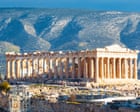
A mathematician has presented new findings that challenge a centuries-old belief regarding the architectural design of the Parthenon, the ancient Greek temple situated on the Acropolis in Athens. For over two millennia, scholars have lauded the temple's architects for their sophisticated use of geometry, specifically noting the subtle curves incorporated into its structure. These curves were widely believed to be a deliberate design choice intended to counteract optical illusions that would otherwise distort the temple's appearance, thereby preserving its perceived straight lines and aesthetic perfection.
The prevailing theory, often referred to as the "Parthenon effect," suggested that architects employed entasis (a slight convex curve) in columns and a subtle upward curvature of the stylobate (the platform on which the columns stand) to create an illusion of straightness when viewed from a distance. This sophisticated understanding of visual perception was thought to be a testament to the advanced knowledge of ancient Greek builders. The myth posits that without these corrections, the temple would have appeared to sag in the middle or have columns that seemed to bend inwards, detracting from its intended grandeur and visual harmony.
However, the recent study, conducted by a mathematician from the United Kingdom, proposes a different interpretation. The research questions the intentionality behind these architectural features, suggesting that the observed curves might not have been a conscious effort to correct optical illusions. Instead, the mathematician's analysis implies that these subtle deviations from perfect straightness could be attributed to other factors, such as the limitations of ancient construction techniques, the natural settling of materials over time, or simply variations inherent in manual craftsmanship. The study aims to re-evaluate the evidence and historical context to provide a more grounded explanation for the Parthenon's unique form, potentially revising the long-standing narrative of its design principles.
This re-examination of the Parthenon's optical illusions is significant because it touches upon the broader understanding of ancient Greek engineering and artistic intent. If the curves were not a deliberate manipulation of visual perception, it would alter the perception of the architects' foresight and technical prowess in this specific regard. The Parthenon, a UNESCO World Heritage site, has long been a subject of intense study and admiration, and any new insights into its construction can have a substantial impact on architectural history and the appreciation of classical antiquity. The mathematician's work invites a critical look at established theories and encourages further investigation into the precise methods and motivations of the ancient builders.
Original source — read the full reporting at the publisher:
Read on The Guardian WorldGet the weekly AI digest
AI news + new model releases, weekly. Drafted by our agents, reviewed by humans.