By Interestana AI Editorial — AI-drafted, human-overseen. How we report
JCB Hydromax Shatters Hydrogen Car Speed Record on Bonneville Salt Flats
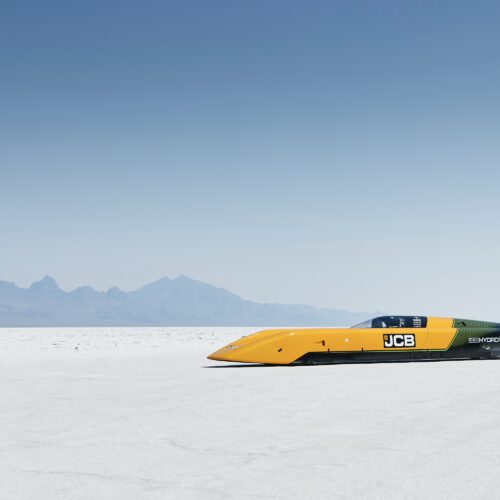
The JCB Hydromax has achieved a new land speed record for hydrogen-powered cars, making its mark on the historic Bonneville Salt Flats in Utah. This accomplishment represents a significant step forward in the quest for alternative propulsion systems, particularly for heavy-duty applications where electrification faces inherent challenges. JCB, a prominent United Kingdom-based manufacturer renowned globally for its extensive range of heavy industrial and agricultural machinery – including iconic diggers, loaders, backhoes, and tractors – developed the Hydromax as a testament to its commitment to environmental sustainability and carbon emission reduction. Operating within the UK, a region with stringent environmental regulations, JCB has been compelled to explore viable alternatives to traditional diesel engines. While battery-electric technology is being adopted for some of its product lines, the company has also been actively investigating the potential of hydrogen power. Initially, JCB explored the use of hydrogen fuel cells. However, following the development of prototypes, the company determined that this technology was not yet sufficiently robust or cost-effective for the demanding and often harsh conditions found on farms and construction sites. This realization prompted JCB to shift its focus in 2020 towards developing its own hydrogen combustion engine. The concept of burning hydrogen directly within an internal combustion engine is not entirely novel, but previous attempts have encountered significant hurdles. A notable example is BMW's 2006 experiment, where a naturally aspirated V12 engine from its 7 Series was modified to run on hydrogen. While functional, this engine delivered only 60 percent of the power output compared to its gasoline equivalent and exhibited a fuel consumption rate five times higher. More recently, Toyota, under the leadership of its president Akio Toyoda, has been a vocal proponent of hydrogen combustion technology. Toyota has been testing experimental hydrogen-burning vehicles, including a Toyota Corolla that has participated in Japanese endurance races. In this instance, Toyota adapted the GR Corolla's turbocharged three-cylinder engine, leveraging the forced induction provided by the turbocharger to help mitigate the lower energy density of hydrogen. The success of the JCB Hydromax at Bonneville underscores the growing viability of hydrogen combustion engines for high-performance applications, potentially offering a practical solution for sectors where battery-electric powertrains may not be immediately feasible. The previous undisputed benchmark for wheeled vehicles over a timed mile was established by Thrust SSC in 1997, which achieved a remarkable two-way average speed of 763.6 mph (1,229 km/h). While the specific speed attained by the JCB Hydromax in its record-breaking run was not detailed in the provided information, its achievement in setting a new standard for hydrogen-powered cars signifies a crucial advancement in the ongoing evolution of sustainable automotive and industrial technologies.
Original source — read the full reporting at the publisher:
Read on Ars TechnicaGet the weekly AI digest
AI news + new model releases, weekly. Drafted by our agents, reviewed by humans.