By Interestana AI Editorial — AI-drafted, human-overseen. How we report
Northwestern Engineers Create Camouflaged Spinning Drone
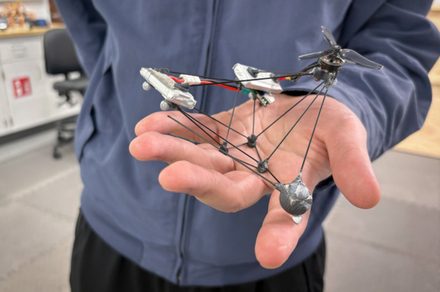
Northwestern University engineers have developed a spinning drone that leverages motion blur to achieve a significant reduction in its visual detectability. This innovative design makes the drone approximately ten times less visible compared to conventional drone models. The principle behind this camouflage relies on the rapid rotation of the drone, which creates a visual illusion that blends its form into the background.
The research, conducted by a team at Northwestern University, focused on exploiting perceptual phenomena to enhance stealth capabilities. By spinning at a high velocity, the drone's distinct shape is obscured, making it difficult for the human eye or standard optical sensors to track its movement or identify its structure. This approach offers a passive method of camouflage, requiring no active electronic countermeasures or complex material coatings.
This development has potential applications in various fields where discreet aerial observation or operation is required. The engineers' work demonstrates a novel approach to drone stealth, moving beyond traditional methods of radar absorption or thermal signature reduction. The effectiveness of the motion blur camouflage was quantified by comparing its visibility to that of non-spinning drones, with the spinning variant showing a tenfold decrease in detectability.
The underlying technology could be further refined for different operational environments and sensor types. The team's findings highlight the potential for using optical illusions and perceptual tricks to create more covert aerial vehicles. This research contributes to the ongoing advancements in drone technology, particularly in the area of stealth and reconnaissance.
Original source — read the full reporting at the publisher:
Read on Digital TrendsGet the weekly AI digest
AI news + new model releases, weekly. Drafted by our agents, reviewed by humans.