By Interestana AI Editorial — AI-drafted, human-overseen. How we report
Concorde Flew at Supersonic Speed to Extend Solar Eclipse Observation
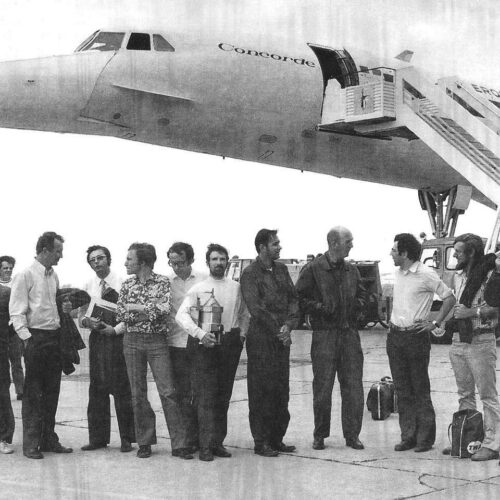
In June 1973, a group of eight scientists aboard a Concorde F-WTSS 001 prototype aircraft achieved a remarkable feat, setting a new world record for observing a total solar eclipse. The aircraft flew at speeds exceeding Mach 2, which is more than twice the speed of sound, allowing the scientists to extend their observation period of the eclipse's totality to an unprecedented 74 minutes. This extended observation window was made possible by the Concorde's supersonic capabilities, enabling it to outpace the Moon's shadow as it traversed the Earth's surface. For context, the maximum duration of totality for a solar eclipse observed from the ground, particularly in equatorial regions, is typically around 7.5 minutes. The Concorde's ability to fly within the path of totality and maintain visual contact with the phenomenon for over an hour dramatically surpassed this terrestrial limit. The Concorde F-WTSS 001 prototype, a significant aircraft in aviation history, is now displayed at the National Air and Space Museum of France, located at the Paris-Le Bourget airport. Its fuselage bears a painted map illustrating the path of the June 1973 solar eclipse across Africa, serving as a visual testament to this extraordinary scientific endeavor. This record-breaking flight highlights the intersection of advanced aerospace technology and astronomical research, demonstrating how innovative engineering can push the boundaries of scientific observation. The achievement underscores the limitations of ground-based observation for phenomena like solar eclipses, where the Earth's rotation and the Moon's shadow's speed impose strict time constraints. The Concorde's supersonic flight offered a unique aerial platform that could effectively 'chase' the eclipse, prolonging the period of totality for scientific study. This event remains a notable example of leveraging cutting-edge technology for scientific discovery, allowing researchers to gather more comprehensive data than would be possible from a stationary ground position. The upcoming solar eclipse on August 12, visible from parts of Europe, is expected to have a maximum ground-based totality duration of slightly over two minutes, further emphasizing the exceptional duration achieved by the Concorde flight. The legacy of this mission is preserved on the aircraft itself, a symbol of both aeronautical prowess and scientific ambition.
Original source — read the full reporting at the publisher:
Read on Ars TechnicaGet the weekly AI digest
AI news + new model releases, weekly. Drafted by our agents, reviewed by humans.