By Interestana AI Editorial — AI-drafted, human-overseen. How we report
Total Solar Eclipse Witnessed in Spain
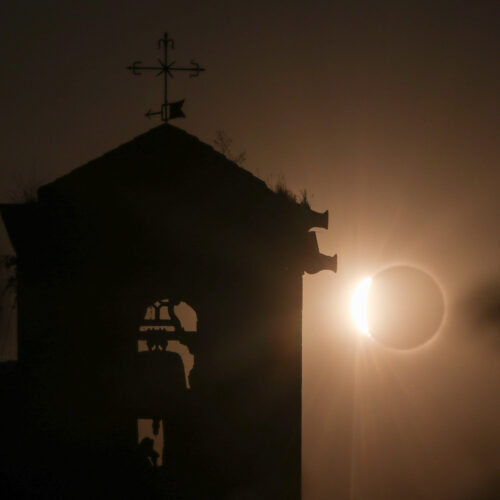
The author recounts their experience witnessing a total solar eclipse in Duratón, Spain, describing it as a rare opportunity to directly sense the mechanics of the Solar System. This celestial event occurs when the Moon, Sun, and Earth align perfectly, a phenomenon made possible by the relative sizes and distances of these bodies. The rarity and grandeur of such an alignment were underscored by the fact that the Moon's shadow had crossed the American heartland twice in less than seven years, in 2017 and again in 2024, both of which the author was fortunate to witness. Impatient to wait for the next total solar eclipse in the continental United States, scheduled for 2044, the author traveled to north-central Spain. The chosen location, characterized by wide open spaces, ancient churches and castles, and vast sunflower fields under a bright August sun, was deemed an ideal spot to experience the path of totality. The ongoing drought in Spain, which had transformed the country's fields and forests into a tinderbox, paradoxically created ideal conditions for eclipse viewing by minimizing atmospheric haze and ensuring clear skies. The author emphasizes the profound impact of standing in the Moon's shadow, a direct sensory experience of cosmic mechanics. The description of the event focuses on the personal awe and the scientific marvel of the alignment, rather than technical details of the eclipse itself. The narrative highlights the subjective experience of witnessing such a powerful natural phenomenon, contrasting the vastness of space with the intimate experience of being in the shadow of the Moon. The article implicitly touches upon the unique geographical and atmospheric conditions that contributed to the viewing experience in Spain, noting the dry climate as a beneficial factor for astronomical observation. The personal narrative serves to convey the profound impression left by the eclipse, motivating the author to seek out such events despite their infrequency. The comparison to previous eclipse experiences in the United States further contextualizes the significance of the Spanish viewing. The narrative concludes with the author's deep engagement with the event, suggesting a lasting impression and a desire for future celestial observations.
Original source — read the full reporting at the publisher:
Read on Ars TechnicaGet the weekly AI digest
AI news + new model releases, weekly. Drafted by our agents, reviewed by humans.