By Interestana AI Editorial — AI-drafted, human-overseen. How we report
SpaceX Launches NASA's Roman Space Telescope
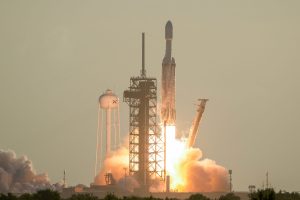
SpaceX launched NASA's Roman Space Telescope on Sunday, a $4.3 billion observatory designed to explore dark energy, dark matter, and exoplanets. The telescope lifted off aboard a Falcon Heavy rocket from Kennedy Space Center shortly after daybreak. This powerful rocket, featuring three core engines, provided the necessary thrust to send the Roman Space Telescope on its journey. The observatory is heading to an observation point 1 million miles (1.6 million kilometers) away, a location that also hosts the James Webb Space Telescope. The Roman Space Telescope, named after Nancy Grace Roman, NASA's first chief astronomer, is bus-sized and will take over three months to reach its final destination. Once operational, it is expected to survey the cosmos with an unprecedented wide field of view, allowing it to uncover hidden aspects of the universe with remarkable speed. NASA science mission director Nicky Fox stated that the telescope is anticipated to discover thousands of supernovae, tens of thousands of planets, billions of galaxies, and tens of billions of stars. The launch itself was a spectacle, with the rocket's two reusable side boosters performing a synchronized landing at Cape Canaveral, creating sonic booms as they returned to Earth. Following the booster separation, the Roman Space Telescope successfully detached from the rocket's upper stage, eliciting applause from NASA's ground control team. NASA Administrator Bill Nelson expressed his excitement, noting the telescope's potential to revolutionize our understanding of the universe. The mission's success was also acknowledged by President Donald Trump, who called NASA Administrator Jared Isaacman to offer congratulations shortly after the launch. Trump described the launch as "beautiful on television" and praised NASA's current achievements in space exploration. The Roman Space Telescope's mission objectives include mapping the distribution of dark energy, a mysterious force accelerating the expansion of the universe, and conducting a comprehensive survey of exoplanets. Its wide-field instrument will enable it to capture vast swathes of the sky in a single observation, significantly increasing the efficiency of astronomical surveys compared to previous missions. This capability is crucial for identifying rare celestial events and objects, fulfilling its mandate to look for 'the weird, the rare and the unusual'. The telescope's advanced optics and sensitive detectors will allow astronomers to study the properties of distant galaxies and the evolution of cosmic structures over billions of years. The data collected by the Roman Space Telescope is expected to fuel numerous scientific discoveries and inspire a new generation of astronomers and astrophysicists.
Original source — read the full reporting at the publisher:
Read on FortuneGet the weekly AI digest
AI news + new model releases, weekly. Drafted by our agents, reviewed by humans.