By Interestana AI Editorial — AI-drafted, human-overseen. How we report
Honeywell, Ecolab Executives Detail AI Limits in Physical World
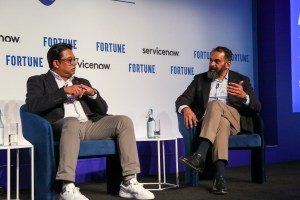
Executives from Honeywell and Ecolab shared insights into the practical limitations of deploying advanced artificial intelligence models within physical industrial and commercial settings at Fortune's AIQ Summit. Suresh Venkatarayalu, Chief Technology Officer at Honeywell, highlighted accuracy as a primary concern for their customers, who require a reliability rate of "99.9999%." He contrasted this demand with the current capabilities of frontier AI models, which he stated could achieve around "85%" accuracy. This gap in precision presents a substantial barrier to widespread adoption in mission-critical and safety-critical applications.
AJ Wijesinghe, Chief AI Officer at Ecolab, focused on the economic constraints of integrating AI into high-volume operations. He described a scenario where utilizing "the best model that’s out there" led to exorbitant "tokenomics," making the AI solution "more expensive than having humans." To address this, Ecolab undertook model optimization efforts that resulted in a significant reduction in token costs, estimated at "about 70% to 80%." Ecolab employs a mix of frontier and open-source models, including those from Anthropic and OpenAI, demonstrating a pragmatic approach to selecting AI tools based on specific needs rather than solely on cutting-edge capabilities.
Both executives downplayed the immediate prospect of fully autonomous systems in their respective domains. Venkatarayalu articulated a vision of a "semi-autonomous world" where human operators gradually build trust in AI systems, emphasizing that "autonomy is also not about removing people." Similarly, Wijesinghe advocated for a "human in the lead" model, asserting that current agent technology is "not matured enough" to operate at scale independently. This perspective underscores the ongoing need for human oversight and intervention in complex physical environments.
Furthermore, the inherent nature of physical infrastructure poses unique challenges compared to software. Unlike a smartphone that can be updated remotely, physical equipment, such as that found in commercial buildings or industrial sites, requires a more cautious approach to updates. While Honeywell is developing over-the-air upgrades for commercial buildings, Venkatarayalu stressed that these will always involve an operator in the loop. He explained that the downtime tolerance for a building is far lower than for a personal vehicle; a building cannot afford to be shut down for "one and a half hours" for an update, unlike a Tesla. Honeywell's recent partnership with Nvidia, announced at its investor day, is partly aimed at fine-tuning open-source models, a strategy driven by customer demands for data sovereignty and control.
Original source — read the full reporting at the publisher:
Read on FortuneGet the weekly AI digest
AI news + new model releases, weekly. Drafted by our agents, reviewed by humans.