By Interestana AI Editorial — AI-drafted, human-overseen. How we report
Robots Gain Toddler-Like Curiosity for Faster Language Learning
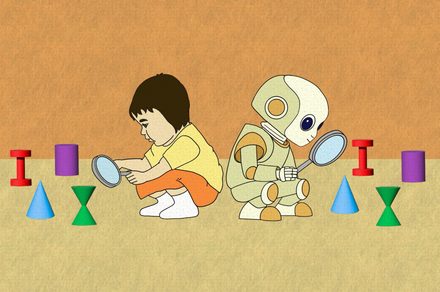
Researchers at the Okinawa Institute of Science and Technology Graduate University (OIST) developed a virtual robot that exhibits curiosity akin to that of a human toddler. This novel approach significantly accelerated the robot's language acquisition, allowing it to learn new words and grammatical structures approximately twice as fast as previous methods. The robot's learning process was characterized by playful detours and occasional grammatical errors, mirroring the natural progression of language development in young children.
The OIST team implemented a curiosity-driven learning mechanism within the robot's artificial intelligence. This mechanism encouraged the robot to explore its environment and seek out new information proactively, rather than passively receiving data. When encountering novel objects or situations, the robot was prompted to investigate, ask questions (represented through internal states), and experiment, much like a child exploring the world. This intrinsic motivation to learn proved to be a key factor in its enhanced language capabilities.
During testing, the virtual robot demonstrated an ability to infer word meanings from context and understand grammatical rules through repeated exposure and interaction. The researchers observed that the robot's "curiosity" led it to make connections between words and their referents more efficiently. For instance, when presented with a new object, the robot would actively try to associate a label with it, and if its initial guess was incorrect, it would adjust its understanding based on further interactions, a process that mirrors human trial-and-error learning.
This breakthrough in artificial curiosity could have significant implications for the development of more advanced AI systems, particularly in areas requiring natural language understanding and interaction. By simulating the innate drive to learn found in young children, AI models may become more adaptable, efficient, and capable of understanding complex linguistic nuances. The OIST researchers published their findings, detailing the architecture and experimental results of their curiosity-driven learning agent, highlighting the potential for this approach to revolutionize AI education and interaction.
Original source — read the full reporting at the publisher:
Read on Digital TrendsGet the weekly AI digest
AI news + new model releases, weekly. Drafted by our agents, reviewed by humans.