By Interestana AI Editorial — AI-drafted, human-overseen. How we report
Rubio in Greece invokes antiquity to champion Trump's 'America First' doctrine
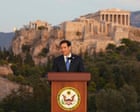
United States Secretary of State Marco Rubio delivered a significant foreign policy address in Athens, Greece, on Wednesday, October 7, 2026, utilizing the iconic backdrop of the Parthenon to champion former President Donald Trump's "America First" doctrine. The speech, widely interpreted as a potential audition for a 2028 presidential campaign, saw Rubio weave a narrative that drew heavily on historical parallels from antiquity, including the founders, philosophers, and conquerors of ancient Greece, to underscore his vision for American foreign policy. He explicitly urged Europe to "awaken from its long slumber" and resist what he characterized as a trajectory towards "atrophy and servitude and decline."
Rubio's invocation of ancient history served as a rhetorical device to frame the "America First" approach, a foreign policy tenet that defined Trump's presidency. This doctrine prioritizes perceived national interests above multilateral cooperation and often expresses skepticism towards international alliances and global institutions. Instead, it advocates for bilateral agreements and a more transactional, self-interested engagement with the world. Rubio's personal narrative, referencing his own family's journey to the United States, was also integrated into his address, aiming to connect the historical narrative of opportunity and resilience with contemporary American identity and purpose.
The choice of Athens, the cradle of Western democracy and philosophy, was a deliberate strategic move. By speaking at the foot of the Parthenon, Rubio sought to imbue his "America First" message with a sense of historical gravitas and enduring Western values, suggesting that a return to a more nationalistic and self-reliant foreign policy was not a departure from, but rather a rediscovery of, foundational principles. This move comes at a time of considerable geopolitical flux, with ongoing debates within the United States and among its allies regarding the nation's role in global security and economic affairs. The "America First" policy, while resonating with a significant portion of the American electorate, has also been a source of contention, with critics arguing that it can strain long-standing alliances and undermine global stability.
Rubio's call for Europe to "awaken" implies a critique of current European foreign policy and economic strategies, suggesting a perceived complacency or a loss of strategic direction. This aligns with the broader "America First" narrative, which often posits that other nations have gained advantages at the expense of American interests. While the speech did not detail specific policy proposals, it provided a broad philosophical justification for a foreign policy that emphasizes national sovereignty, economic protectionism, and a more restrained, albeit assertive, global engagement. The address aimed to present a vision of American leadership rooted in a selective interpretation of history and a strong emphasis on national self-interest.
Original source — read the full reporting at the publisher:
Read on The Guardian WorldGet the weekly AI digest
AI news + new model releases, weekly. Drafted by our agents, reviewed by humans.