By Interestana AI Editorial — AI-drafted, human-overseen. How we report
Researchers Create Full-Color Infrared Night Vision Goggles
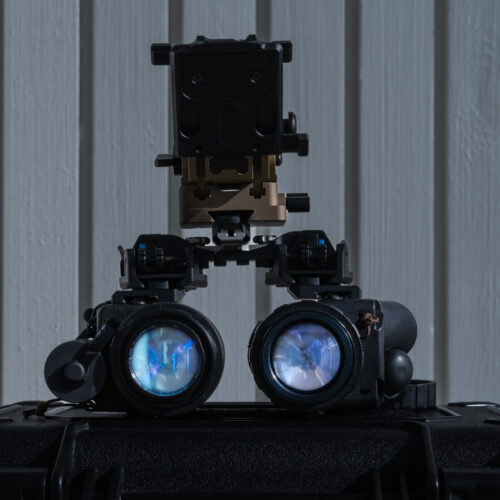
Researchers at the Beijing Institute of Technology have developed a novel device that allows humans to perceive infrared light in full color, a significant advancement over traditional night vision technology. The team, led by Xin Tang and Ge Mu, has engineered goggles that translate different infrared wavelengths into distinct colors within the visible spectrum, thereby approximating natural human vision. This innovation addresses the inherent limitation of human eyes, which cannot naturally detect infrared photons due to their insufficient energy to activate the signaling pathways in light-sensing cells. Standard night vision devices typically convert infrared signals into monochromatic shades of green, offering a limited representation of the environment. The new goggles achieve their full-color infrared perception by integrating mercury telluride colloidal quantum dots with a dual-layer organic light-emitting diode (OLED). The quantum dots are specifically designed to absorb infrared light. This absorbed energy is then converted into visible light by the OLED layer. When these components are stacked and interconnected with appropriate internal wiring, the device processes incoming infrared radiation and outputs it as a full-color image that appears ordinary to the human eye. This technology has the potential to enhance situational awareness and operational capabilities in low-light or infrared-rich environments. The development represents a leap forward in optical sensing and human-computer interface design, moving beyond simple detection to a more intuitive and information-rich visual experience. Further research may explore applications in fields such as security, wildlife observation, and industrial inspection, where detailed visual information in challenging lighting conditions is critical. The ability to distinguish between different infrared signatures based on color could provide a richer understanding of an environment compared to grayscale or single-color representations. This breakthrough could pave the way for more sophisticated visual aids that augment human perception in ways previously confined to science fiction. The specific materials used, mercury telluride colloidal quantum dots and dual-layer OLED, are key to the device's functionality, enabling the precise absorption and conversion of infrared light into a spectrum of visible colors. The researchers' successful integration of these components signifies a notable achievement in materials science and optoelectronics.
Original source — read the full reporting at the publisher:
Read on Ars TechnicaGet the weekly AI digest
AI news + new model releases, weekly. Drafted by our agents, reviewed by humans.