By Interestana AI Editorial — AI-drafted, human-overseen. How we report
Astronomers Discover "Black Hole Star"
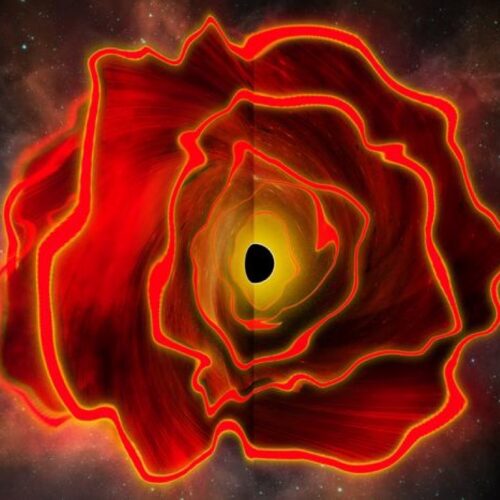
Astronomers have identified a novel celestial object, dubbed a "black hole star," which exhibits characteristics unlike any previously known astrophysical entity. This discovery emerged from an analysis of data collected by the James Webb Space Telescope in 2024, which revealed hundreds of enigmatic small red dots believed to be nascent quasars existing within the first few hundred million years of the universe's existence. One particular red dot stood out due to its extreme redness and luminosity, properties that did not align with existing astrophysical models. Subsequent investigation by scientists has led to the conclusion that this object is a "black hole star." The designation arises from its physical dimensions, comparable to a large star, yet its energy output far surpasses that which could be generated through nuclear fusion. Instead, its energy production is comparable to the output of an active black hole. This finding challenges current astrophysical understandings and opens new avenues for research into the early universe and the formation of extreme celestial objects. The research involved astronomers examining data from the James Webb Space Telescope, a powerful infrared observatory launched in December 2021. The telescope's advanced capabilities allow it to observe distant and faint objects, providing unprecedented insights into cosmic history. The identification of "baby quasars" suggests that active galactic nuclei were more prevalent in the early universe than previously thought. The "black hole star" represents a significant anomaly within this context, prompting further study to understand its formation mechanism and its implications for cosmological models. The research team, including astronomers like Rohan Naidu from the University of Hawai'i, is continuing to analyze the data and conduct follow-up observations to gather more information about this unique object. The implications of this discovery could extend to our understanding of black hole formation, stellar evolution, and the conditions of the early universe. The energy output of the "black hole star" is particularly noteworthy, suggesting processes beyond standard stellar physics are at play. This finding underscores the ongoing scientific exploration and the potential for unexpected discoveries with advanced observational tools like the James Webb Space Telescope. The scientific community anticipates further publications detailing the specific properties and theoretical explanations for this extraordinary celestial phenomenon. The existence of such an object could necessitate revisions to existing theories regarding the life cycle of stars and the nature of compact objects in the cosmos. The precise mechanisms driving the immense energy output of the "black hole star" remain a subject of intense scientific inquiry.
Original source — read the full reporting at the publisher:
Read on Ars TechnicaGet the weekly AI digest
AI news + new model releases, weekly. Drafted by our agents, reviewed by humans.