By Interestana AI Editorial — AI-drafted, human-overseen. How we report
Physicist Analyzes Star Trek's Picard Maneuver
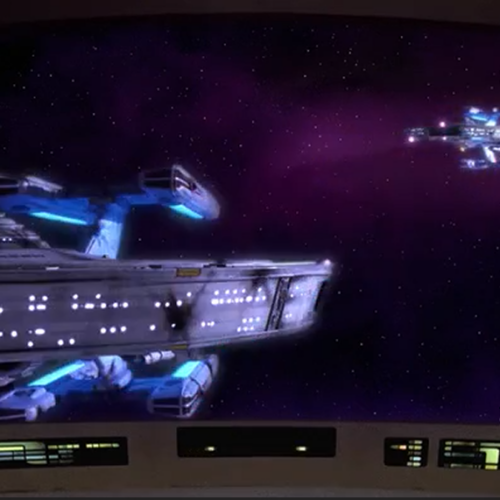
Physicist Níckolas de Aguiar Alves, affiliated with the Federal University of ABC in Brazil, has conducted a detailed analysis of the "Picard Maneuver" depicted in the first season of "Star Trek: The Next Generation." The maneuver, first described in the episode "The Battle," involves a starship captain charging an enemy at faster-than-light (warp) speed, then abruptly stopping to fire. The core concept, as presented in the show, was that the enemy would perceive two images of the attacking ship: one at the point where warp speed was initiated and another at the stopping point. By firing at the perceived "ghost" image, the enemy would miss the actual ship, allowing the attacker to gain an advantage. Alves's research, however, uncovers a deeper relativistic implication that was not explicitly detailed in the original script. He found that the maneuver, when examined through the lens of Einstein's theory of relativity, becomes even more sophisticated. The phenomenon of seeing multiple images of a moving object is related to the aberration of light, a real-world effect where the apparent direction of light changes due to the observer's motion. In the context of the Picard Maneuver, the rapid acceleration and deceleration at warp speeds would indeed cause significant relativistic effects. The enemy ship, observing the Stargazer's approach, would experience a distortion in the perceived position of the Stargazer due to the aberration of light. This aberration would cause the Stargazer to appear in a different location than its actual position at any given moment. Alves's analysis suggests that the writers may have intuitively grasped a complex relativistic phenomenon. The maneuver's effectiveness hinges on the enemy's reaction time and their ability to accurately track a target moving at extreme velocities. The perceived "two images" could be interpreted as the result of the aberration of light, where the light arriving from the Stargazer at different points in its trajectory would be seen by the enemy at slightly different apparent positions. This makes the maneuver not just a clever tactical gambit but also a compelling illustration of how relativistic effects can influence observations in space. Alves's work highlights how science fiction can inspire scientific inquiry, and how real-world physics can add layers of complexity and wonder to fictional concepts. The analysis provides a valuable opportunity to teach about the lesser-known aspects of the theory of relativity, specifically the aberration of light and its implications for high-speed travel and observation.
Original source — read the full reporting at the publisher:
Read on Ars TechnicaGet the weekly AI digest
AI news + new model releases, weekly. Drafted by our agents, reviewed by humans.