By Interestana AI Editorial — AI-drafted, human-overseen. How we report
Paid Media Forecasts Fail Due to Inflation, Volatility
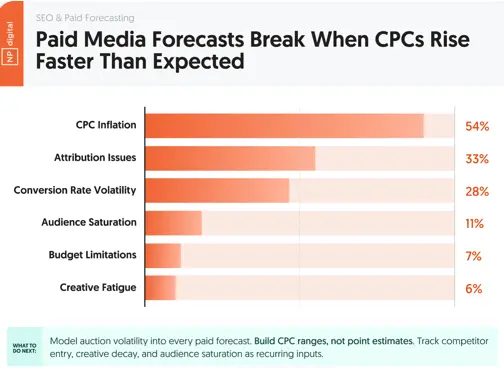
Paid media forecasts most commonly fail due to cost-per-click (CPC) inflation and conversion rate volatility, rather than fundamental strategy flaws. New campaigns typically experience negative performance for their initial weeks as algorithms learn and optimize. Forecasts that omit this crucial ramp-up period set unrealistic expectations that are unlikely to be met. Creative decay, a predictable factor, should be integrated into paid media forecasts from their inception. The increasing reliance on AI bidding within platforms like Google and Meta is further diminishing predictability. While bid strategy adjustments are often assumed to have a significant impact, their direct influence is less substantial than commonly believed. The established framework for paid media forecasting progresses sequentially: first, forecast reach, then efficiency, and finally, profitability, with each stage informing the subsequent one. A common scenario involves a forecast predicting a 4x return on ad spend (ROAS) by the second month, only for CPCs to rise, click-through rates (CTR) to decline, and leadership to question the performance without adequate explanations. This divergence between projection and reality often stems from a forecasting problem, not a strategic one. The majority of paid media forecasts falter not due to mathematical inaccuracies by marketers, but because they are built on assumptions that do not align with the realities of auction dynamics. Factors such as CPC inflation, conversion rate volatility, creative decay, and the unpredictability of AI bidding create discrepancies between model projections and actual campaign delivery. This analysis aims to identify the root causes of these gaps and provide guidance on constructing paid media forecasting models that incorporate real-world variables from the outset, thereby ensuring future forecasts are more robust and reliable. The primary pressure points where most paid media forecasts break are consistent. Identifying the specific variable responsible for a forecast miss is as critical as developing the next forecast, as the same failure patterns tend to recur if the cause is not isolated. Data from NP Digital, analyzing campaigns across various industries, indicates that CPC inflation is the leading cause of paid forecast failures, accounting for 54 percent of such instances. CPCs are fundamentally driven by auction dynamics, not solely by advertiser intent. Increased competition, shifts in quality scores, and updates to platform algorithms can all contribute to CPCs exceeding forecast assumptions more rapidly than most models can accommodate. Therefore, incorporating these dynamic auction behaviors into forecasting models is essential for greater accuracy.
Original source — read the full reporting at the publisher:
Read on Neil PatelGet the weekly AI digest
AI news + new model releases, weekly. Drafted by our agents, reviewed by humans.