By Interestana AI Editorial — AI-drafted, human-overseen. How we report
Czinger 21C Spyder Features Organic-Looking Brake Assemblies
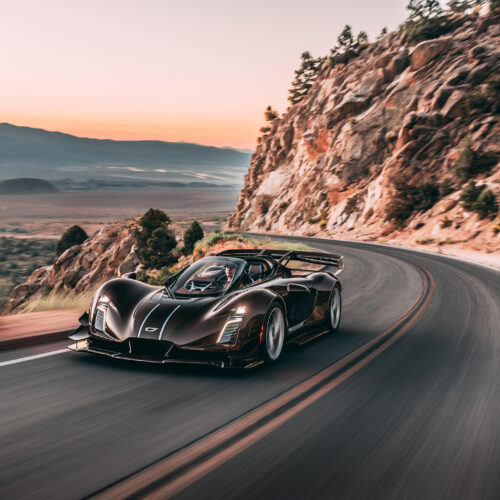
Czinger unveiled its new 21C Spyder at Monterey Car Week, an annual gathering of automotive enthusiasts and events in California. This latest creation from Czinger highlights advancements in their direct-metal laser-sintering technology, a process the company's founder, Kevin Czinger, was involved with a decade prior under the name Divergent 3D. Divergent 3D initially focused on developing this additive manufacturing technique, with the intention of becoming a parts supplier to the automotive industry. The success of this strategy led to Divergent 3D securing clients in both the automotive and aerospace sectors.
The Czinger 21C Spyder itself is a hybrid vehicle featuring tandem seating and designed for high performance, capable of setting new lap records. However, the vehicle's engineering innovations are considered more significant than its performance metrics. When stripped of its body panels, the car's structural components, including its brake assemblies, exhibit a more organic appearance. This aesthetic is a direct result of topology optimization, a design process that creates lighter yet equally effective structures compared to traditional engineering methods. Topology optimization allows for the creation of complex, organic shapes that are precisely engineered to meet performance requirements while minimizing material usage and weight.
Monterey Car Week, described as a significant event for the automotive world, attracts a large number of affluent individuals and influencers. The event has grown considerably over the years, often characterized by high demand and increased costs for accommodations and travel. Despite the logistical challenges of attending in person, the week remains a crucial platform for automotive manufacturers and designers to debut new technologies and vehicles. Czinger's participation with the 21C Spyder underscores the company's commitment to pushing the boundaries of automotive design and manufacturing through advanced additive manufacturing techniques.
The company's foundational technology, direct-metal laser sintering, enables the creation of intricate and lightweight parts that were previously difficult or impossible to produce with conventional manufacturing. This technology allows for the direct printing of metal components from digital designs, offering unparalleled design freedom. The organic forms seen in the 21C Spyder's structure are a testament to the capabilities of this technology, demonstrating how advanced engineering can result in both functional and visually striking automotive components. The brake assemblies, in particular, exemplify this fusion of form and function, presenting a departure from the typically mechanical appearance of such parts.
Original source — read the full reporting at the publisher:
Read on Ars TechnicaGet the weekly AI digest
AI news + new model releases, weekly. Drafted by our agents, reviewed by humans.