By Interestana AI Editorial — AI-drafted, human-overseen. How we report
Mount Toba Eruption's Global Cooling Effect Was Brief
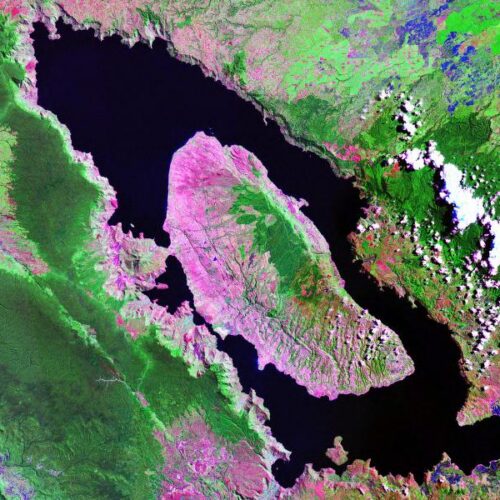
The colossal eruption of Mount Toba approximately 74,000 years ago, the largest volcanic event in the past 2.6 million years, may not have posed an existential threat to early humans as previously theorized. This supervolcanic eruption, originating from a caldera in present-day Sumatra, expelled thousands of cubic kilometers of magma over a two-week period. For context, this volume is roughly one thousand times greater than the amount of material ejected by the 1991 Mount Pinatubo eruption. The prevailing hypothesis suggested that the Toba eruption could have triggered significant global cooling, thereby imperiling the survival of human ancestors. This theory posits that volcanic eruptions inject sulfur dioxide into the stratosphere, which forms a haze of microscopic droplets that reflect solar radiation back into space, leading to a cooling effect. The magnitude of this cooling is generally proportional to the amount of sulfur dioxide released. However, a new study, led by geoscientist Jinheum Park of Johannes Gutenberg University in Mainz, Germany, examined sediment cores from a small crater lake on the Kenya-Tanzania border to reconstruct the environmental impact of the eruption. The findings from this mud analysis indicate that the cooling effects attributed to the Mount Toba eruption were relatively short-lived, lasting for less than two years. Furthermore, the study estimates that the global temperature decrease during this period was approximately half a degree Celsius. This duration and magnitude of cooling are significantly less severe than what would be required to support theories of a near-extinction event for humanity. The research also sheds light on the physics of volcanic aerosols. While larger eruptions inject more sulfur dioxide, leading to greater cooling, this effect has a limit. Park explains that larger sulfate aerosols tend to settle out of the atmosphere more quickly due to their increased weight. This faster sedimentation reduces their efficacy in scattering incoming solar radiation, thereby limiting the duration and intensity of the cooling phenomenon. The sediment cores, acting as a form of "muddy calendar," provided a detailed chronological record of environmental changes, allowing researchers to pinpoint the specific timeframe and severity of the cooling event following the Toba eruption. This new evidence challenges long-held assumptions about the catastrophic impact of the Toba supervolcano on human evolution and survival.
Original source — read the full reporting at the publisher:
Read on Ars TechnicaGet the weekly AI digest
AI news + new model releases, weekly. Drafted by our agents, reviewed by humans.