By Interestana AI Editorial — AI-drafted, human-overseen. How we report
Global Household Wealth Surged $40 Trillion in 2025
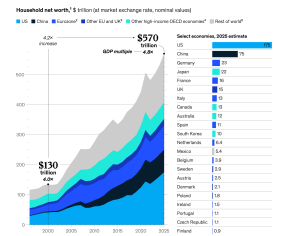
Global households experienced a record increase in wealth, adding $40 trillion in 2025 and bringing total household net worth to $570 trillion. This represents a 7.3% jump, exceeding the average annual growth rate of 5.9% observed since the year 2000. Concurrently, the world's overall balance sheet of assets expanded to nearly $1.8 quadrillion. These figures, detailed in the McKinsey Global Institute's "Global Balance Sheet 2026: Imbalance and Divergence" report, mark new historical highs. The total wealth has more than quadrupled since 2000 in nominal terms and at market exchange rates, growing at a faster pace than global Gross Domestic Product (GDP). McKinsey noted this rapid expansion raises questions about the health and stability of the global economy, particularly as the growth is not uniform across all countries.
While household wealth per capita is increasing in most nations, it is largely not keeping pace with GDP growth. The McKinsey report attributes this trend to slowing real estate values, as property constitutes the largest portion of household wealth in most economies. The United States and Australia stand out with the highest wealth per capita, and both countries saw their household wealth expand by at least 20 percentage points of GDP. This indicates a significant increase in the relative size of household wealth compared to their respective economic outputs.
The substantial wealth increase in 2025 is characterized as predominantly a "paper" phenomenon rather than a reflection of genuine economic expansion. Only approximately 20% of the newly accumulated household wealth originated from real capital formation, which involves actual investment in productive assets. In contrast, equities alone contributed 57% of the new wealth, while real estate accounted for a mere 15%. This marks a significant departure from the historical pattern observed between 2000 and 2024, when real estate was the primary driver of wealth gains. The report highlights the increasing dominance of financial assets over tangible investments in wealth accumulation.
Equity values in the U.S. reached 2.4 times corporate net assets in 2025, nearly double the historical average. The "Magnificent Seven" mega-cap stocks, largely associated with artificial intelligence, were responsible for just over half of the S&P 500's market capitalization growth from 2021 through 2025. This concentration of value underscores the growing influence of technology and AI-driven companies on the broader market. The United States now holds nearly half of the total corporate equity value among major global economies, a share that has substantially increased over the past 15 years. This concentration implies that American corporate earnings and market performance have a disproportionately large impact on global financial metrics and household wealth.
Original source — read the full reporting at the publisher:
Read on FortuneGet the weekly AI digest
AI news + new model releases, weekly. Drafted by our agents, reviewed by humans.