By Interestana AI Editorial — AI-drafted, human-overseen. How we report
South Korean Stocks Trade at Record Low Valuations
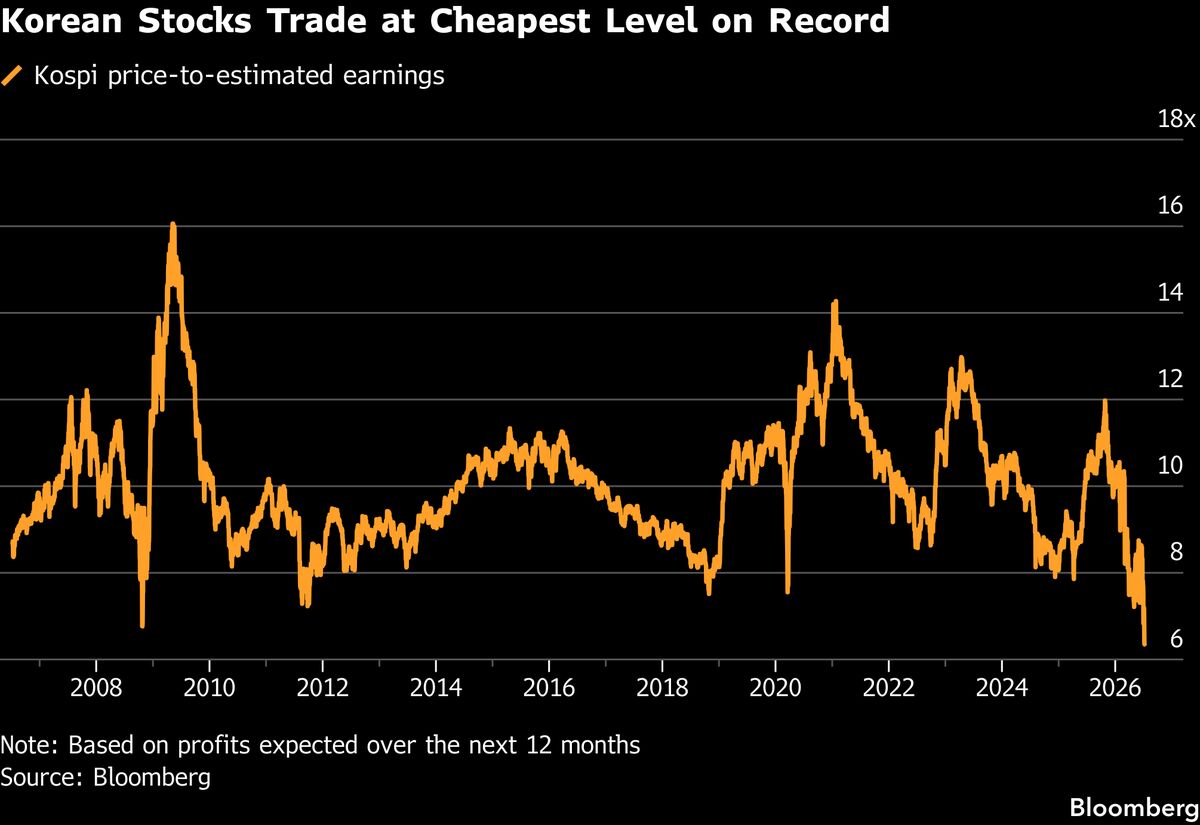
South Korea's stock market has experienced a significant rally, yet its equities are currently trading at historically low valuations. This divergence presents an unusual scenario for investors, suggesting a potential disconnect between market performance and underlying asset pricing.
The benchmark KOSPI index has seen substantial gains, driven by strong performance in key sectors. However, valuation metrics such as the price-to-earnings (P/E) ratio and price-to-book (P/B) ratio for the broader market have fallen to levels not seen in years. This indicates that despite rising stock prices, the earnings and book values of companies have not kept pace, or that the market is pricing in future uncertainties more aggressively.
Analysts attribute this phenomenon to a combination of factors. Global economic uncertainties, including inflation concerns and geopolitical tensions, are leading investors to seek safer assets, potentially overlooking emerging markets like South Korea. Furthermore, specific domestic issues, such as the 'Korea Discount'—a term referring to the persistent undervaluation of Korean companies compared to their global peers—continue to play a role. This discount is often linked to corporate governance concerns and a lack of shareholder-friendly practices among some of the country's large conglomerates, known as chaebols.
Despite these challenges, some market participants view the current low valuations as an attractive entry point. They argue that the underlying economic fundamentals of South Korea remain robust, supported by its strong export-oriented economy, technological prowess in semiconductors and electronics, and a growing focus on innovation. The government has also been making efforts to address the Korea Discount by encouraging corporate reforms and improving shareholder returns, which could lead to a re-rating of the market in the future.
Original source — read the full reporting at the publisher:
Read on Bloomberg MarketsGet the weekly AI digest
AI news + new model releases, weekly. Drafted by our agents, reviewed by humans.