Indian Stocks, Rupee Fall on Trump's Iran Remarks
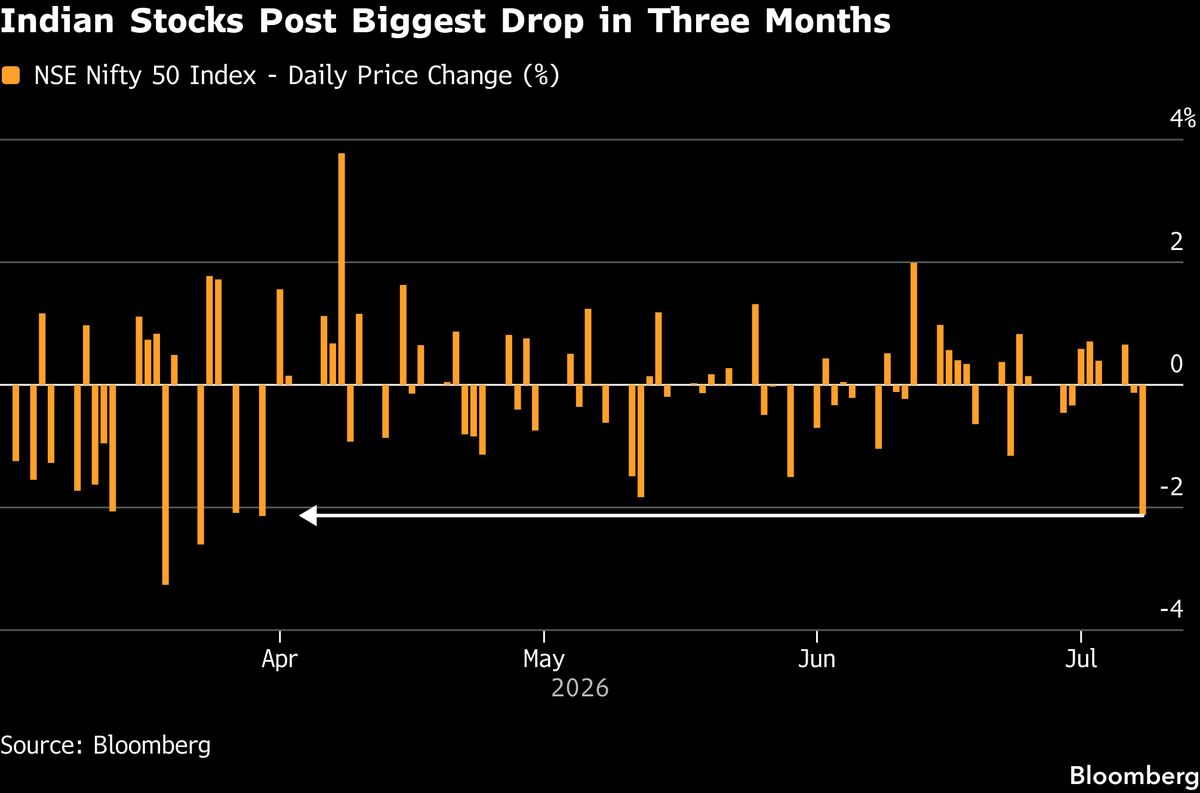
Indian equity markets experienced a significant downturn, with the benchmark Sensex index falling by 1.5% and the Nifty 50 dropping 1.6% on Tuesday. The Indian rupee also depreciated against the US dollar, trading at 83.50 INR/USD, its lowest point in over a month. This market reaction followed remarks made by US President Donald Trump on Monday, indicating that the "tentative ceasefire" with Iran had concluded.
Trump's statement was a direct response to recent attacks on commercial vessels navigating the Strait of Hormuz, a critical chokepoint for global oil supply. The renewed geopolitical tension in the Middle East led to a surge in crude oil prices, with Brent crude futures climbing 2.1% to $85.50 per barrel and WTI crude futures rising 1.9% to $81.20 per barrel. Higher oil prices typically translate to increased import costs for India, a major oil-importing nation, thereby impacting its trade deficit and currency.
The Reserve Bank of India (RBI) was reportedly monitoring the situation closely, with traders speculating about potential intervention to stabilize the rupee. Analysts at ICICI Securities noted that the heightened uncertainty in the energy markets could lead to increased volatility in Indian equities for the coming trading sessions. The broader Asian markets also saw a negative trend, with the MSCI Asia ex-Japan Index down 0.8% as investors assessed the implications of the escalating US-Iran tensions.
Foreign institutional investors (FIIs) continued their cautious stance, with net outflows of INR 1,200 crore from Indian equities observed in the past week, according to data from the National Securities Depository Limited (NSDL). The current geopolitical climate, coupled with concerns over global inflation and interest rate trajectories, is expected to weigh on investor sentiment. The Indian government has stated its commitment to managing economic stability amidst external shocks, but the immediate outlook remains sensitive to further developments in the Middle East.
Original source — read the full reporting at the publisher:
Read on Bloomberg Markets