By Interestana AI Editorial — AI-drafted, human-overseen. How we report
Fruit Flies Navigate Complex Odor Plumes With Advanced Strategy
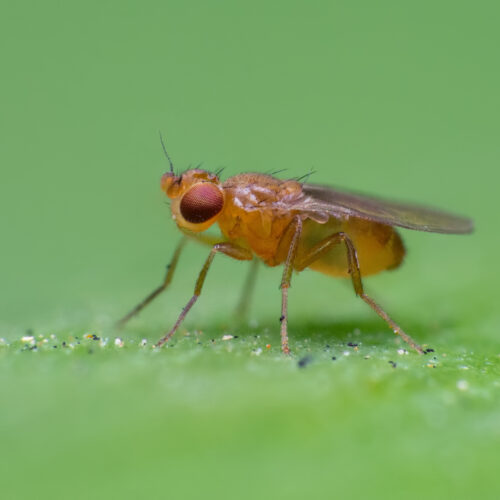
Fruit flies navigate to their food sources or mates by following plumes of odor, a process complicated by turbulent air that breaks these plumes into discontinuous filaments. Scientists have long sought to understand how these insects, with their tiny brains, manage to follow these chaotic and intermittent scent signals. Previously, the prevailing scientific model was the "surge and cast" hypothesis, which suggested that insects relied on hardwired reflexes. This model proposed that upon detecting an odor plume with olfactory neurons in their antennae, flies would fly directly upwind until the scent disappeared, then cast side-to-side to reacquire it. However, this model struggled to adequately explain how insects could track meandering plumes over significant distances, especially given the often sparse and unreliable nature of chemical cues in the natural environment.
New research spearheaded by Vanessa Ruta, a neuroscientist at Rockefeller University, has unveiled a more sophisticated navigation strategy employed by fruit flies. This advanced mechanism challenges the simplicity of the "surge and cast" model. The difficulty in studying olfactory navigation stems from the invisible nature of odors and their unpredictable dispersal by turbulent airflow, making it challenging to determine precisely what an animal is smelling at any given moment. This inherent complexity has made experimental verification of navigation strategies particularly arduous for researchers.
Ruta's team developed an innovative experimental setup that allowed them to precisely control and measure the olfactory environment experienced by fruit flies. By using a specialized treadmill system, they could present flies with controlled odor plumes while simultaneously tracking the flies' movements and neural activity. This enabled them to observe the flies' responses to realistic, albeit controlled, odor landscapes. The findings indicated that fruit flies do not solely rely on simple upwind surges and random casting. Instead, they exhibit a more nuanced approach that involves actively interpreting the temporal and spatial patterns of the odor signals.
This advanced strategy allows fruit flies to make more informed decisions about their flight path, even when presented with fragmented and directionally ambiguous scent information. The research suggests that flies are capable of integrating information from successive odor encounters to infer the direction of the odor source. This implies a higher level of cognitive processing than previously attributed to their small brains, moving beyond a purely reflexive response. The implications of this discovery extend to our understanding of sensory processing and navigation in biological systems, potentially informing the design of bio-inspired robots and navigation algorithms. The study, published in a peer-reviewed journal, provides concrete evidence for a more complex olfactory navigation system in fruit flies than the long-standing "surge and cast" model predicted.
Original source — read the full reporting at the publisher:
Read on Ars TechnicaGet the weekly AI digest
AI news + new model releases, weekly. Drafted by our agents, reviewed by humans.