By Interestana AI Editorial — AI-drafted, human-overseen. How we report
Chimpanzees Teach Offspring Tool Use Via Social Learning
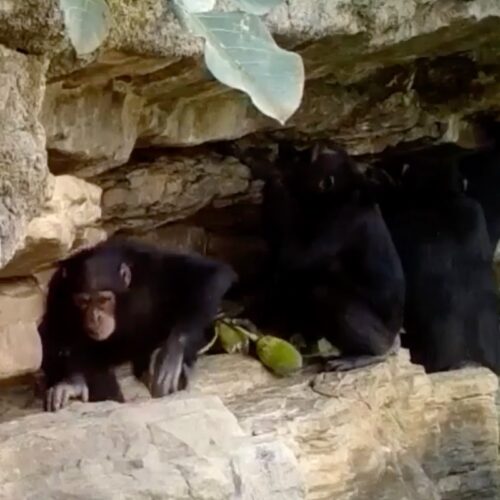
Chimpanzees actively transmit tool-use knowledge to their offspring through social learning, a behavior detailed in a new paper published in the journal Frontiers in Psychology. This process involves adult chimpanzees deliberately demonstrating how to use tools for foraging and then transferring these tools to younger individuals. This transfer allows the young chimps to mimic the observed motions and learn the technique. According to co-author Andreu Sánchez-Megías, a graduate student at the University of Barcelona and the Jane Goodall Institute Spain in Senegal, receiving food and tools from experienced chimpanzees, a practice termed food or tool transfer, likely aids in learning to extract difficult-to-access foods. Sánchez-Megías further explained that tool transfers appear to function as a form of teaching, complementing observation and supervised practice, with mothers serving as the primary models and educators for their young.
Historically, tool use was considered a unique human characteristic. However, Charles Darwin noted chimpanzees using stones to crack nuts as early as 1871. A significant observation by primatologist Jane Goodall in 1960 involved a chimpanzee named David Greybeard, who modified a twig to extract termites. This discovery prompted Goodall's mentor, Louis Leakey, to question the definitions of "tool" and "man," suggesting a re-evaluation of the distinction between humans and chimpanzees. Since these foundational observations, chimpanzees have been documented engaging in a variety of sophisticated tool-making and usage behaviors. These include creating sponges from leaves to absorb liquids, shaping sticks to collect algae, and fashioning rudimentary spears for hunting purposes. These findings underscore the complex cognitive abilities and cultural transmission present within chimpanzee societies, challenging previous anthropocentric views on tool use and intelligence.
The research highlights the deliberate nature of this intergenerational knowledge transfer. Adult chimpanzees do not merely use tools incidentally; they actively engage in behaviors that facilitate learning in their young. This includes not only demonstrating the action but also providing the physical means—the tool itself—for the offspring to practice. The emphasis on mothers as the main teachers suggests a strong familial component in the transmission of these learned skills. This social learning mechanism is crucial for chimpanzees to acquire the complex foraging strategies necessary for survival, particularly for accessing resources that require specialized techniques and tools. The study contributes to a broader understanding of animal cognition and the evolution of teaching behaviors in non-human primates, suggesting that sophisticated forms of cultural transmission are present in species closely related to humans.
The implications of this research extend beyond understanding chimpanzee behavior. It provides insights into the evolutionary roots of teaching and learning, potentially shedding light on the development of these capacities in early hominins. The deliberate modeling and tool transfer observed in chimpanzees suggest that the foundations for complex pedagogy may predate the emergence of Homo sapiens. By studying these behaviors in our closest living relatives, scientists can gain a deeper appreciation for the biological and social mechanisms that underpin the development of complex skills and knowledge across generations. The ongoing research into chimpanzee tool use continues to challenge our understanding of animal intelligence and the unique characteristics once thought to define humanity.
Original source — read the full reporting at the publisher:
Read on Ars TechnicaGet the weekly AI digest
AI news + new model releases, weekly. Drafted by our agents, reviewed by humans.