By Interestana AI Editorial — AI-drafted, human-overseen. How we report
ETH Zurich Researchers Develop Self-Contained Walking Robotic Hand
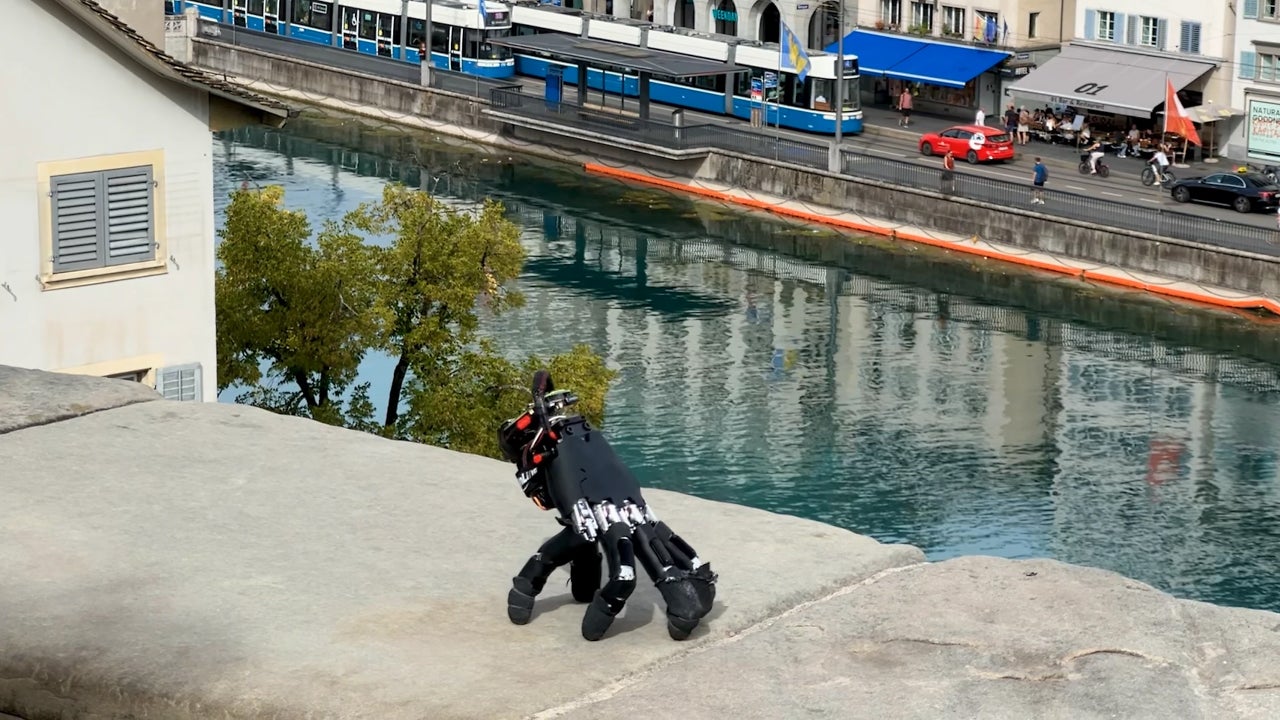
Researchers at ETH Zurich's Soft Robotics Lab have developed a novel robotic hand that operates independently of a full robotic body, capable of walking, balancing, and manipulating objects using only its five digits. This innovation, inspired in part by the character Thing from 'The Addams Family,' addresses a long-standing challenge in robotics: enabling autonomous systems to perform tasks in confined or inaccessible spaces without the need for bulky mechanical arms or rovers. Amirhossein Kazemipour, a PhD candidate at the lab and one of the project's researchers, stated that the inspiration from 'The Addams Family' was a personal enjoyment, but the practical applications are significant. The core concept is to grant the hand autonomy, allowing its fingers to not only interact with objects but also to facilitate movement and maintain balance, thereby eliminating the need for a supporting limb to carry it to its task.
This self-contained design offers several advantages over traditional robotic systems. By integrating locomotion and manipulation into a single unit, the engineers have bypassed the added weight, mechanical complexity, and potential failure points associated with dedicated wheels or secondary limbs. The researchers, including Hehui Zheng and Robert Katzschmann, detailed their findings in a recent paper, explaining how their invention overcomes the kinematic challenges of enabling a humanoid hand to move and interact dexterously. The ability for the digits to perform a dual role as both manipulators and walking appendages represents a significant step towards more versatile and adaptable robotic systems. This approach is particularly beneficial for applications requiring inspection of equipment or operation of switches within tight enclosures, where conventional robotic arms or rovers would be impractical.
The development at ETH Zurich, a Swiss public research university, focuses on creating a system that can move and interact with its environment with a high degree of dexterity. The traditional paradigm in robotics often involves a robotic hand being attached to a wrist and arm, requiring the entire assembly to be positioned by a larger robotic structure. The ETH Zurich team's approach decouples the hand from this dependency, allowing it to navigate and perform tasks autonomously. This independence is crucial for future advancements in fields such as in-situ repair, exploration of hazardous environments, and intricate assembly tasks where precision and maneuverability are paramount. The researchers are working to refine the control systems and locomotion capabilities of the hand, aiming to enhance its agility and ability to traverse varied terrains and complex geometries. The project highlights a growing trend in robotics towards more modular and specialized robotic components that can operate with greater autonomy and adapt to a wider range of operational contexts.
Original source — read the full reporting at the publisher:
Read on Fast CompanyGet the weekly AI digest
AI news + new model releases, weekly. Drafted by our agents, reviewed by humans.