By Interestana AI Editorial — AI-drafted, human-overseen. How we report
Physicists Find New Evidence for Glueball Particles
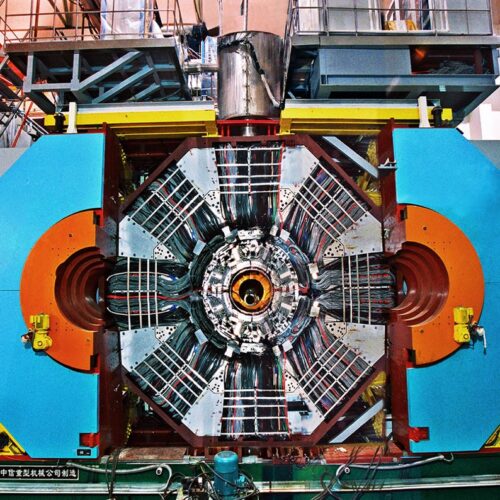
Physicists operating the Beijing Spectrometer III (BES III) experiment have identified compelling new evidence supporting the existence of glueballs, a theoretical composite particle composed solely of gluons. These particles are a direct prediction of quantum chromodynamics, the theory governing the strong nuclear force. The findings were initially published in a preprint on arXiv last month and subsequently presented at the International Conference on High Energy Physics (ICHEP) last week. The Standard Model of Particle Physics describes the fundamental constituents of matter, including quarks, which are bound together by gluons to form protons and neutrons. These, in turn, constitute the atomic nucleus. While the discovery of the Higgs boson in 2012 was a significant milestone, confirming a key prediction of the Standard Model, the existence of glueballs remains an open question within the field. Quantum chromodynamics, the theory of the strong nuclear force, explicitly predicts the formation of glueballs, suggesting that multiple types of these gluon-bound states should exist. The BES III experiment, located at the Institute of High Energy Physics in Beijing, China, is designed to study the properties of subatomic particles produced in electron-positron collisions. The experiment's primary goal is to investigate the physics of light mesons and baryons, seeking to understand the fundamental forces and particles that make up the universe. The search for glueballs has been ongoing for decades, with various experiments attempting to detect these elusive particles. Their existence is crucial for a complete understanding of the strong nuclear force and the structure of matter. If confirmed, the discovery of glueballs would provide strong validation for the predictions of quantum chromodynamics and potentially open new avenues for exploring the fundamental nature of the universe. The current evidence presented by the BES III collaboration is considered by many in the physics community to be the most significant indication to date of glueball existence. Further analysis and independent verification by other experiments will be necessary to definitively confirm this discovery and fully characterize the properties of these predicted particles. The implications for particle physics could be profound, reinforcing our current theoretical frameworks or prompting revisions to our understanding of fundamental interactions.
Original source — read the full reporting at the publisher:
Read on Ars TechnicaGet the weekly AI digest
AI news + new model releases, weekly. Drafted by our agents, reviewed by humans.