By Interestana AI Editorial — AI-drafted, human-overseen. How we report
Google Rolls Out Guidance for Text Disclaimers in Search Ads, Enhancing Compliance for Regulated Industries
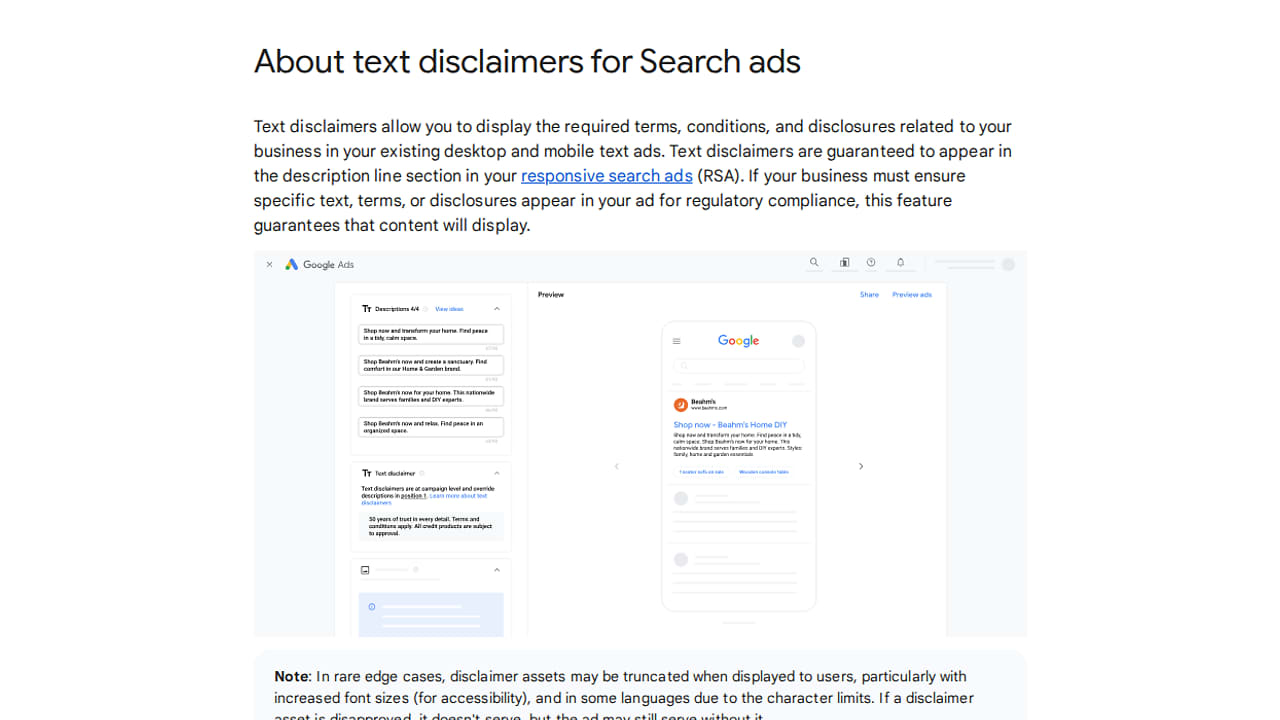
Google has officially published comprehensive guidance on its Help Center page regarding text disclaimers within Search advertisements. This new feature allows advertisers to incorporate mandatory terms, conditions, and legal disclosures directly into their ads, a crucial development for businesses operating in regulated sectors. The functionality is now available globally and is specifically designed to support campaigns utilizing Google's AI Max (formerly Performance Max) campaign management system.
The updated documentation meticulously explains the process for advertisers to create and manage these text disclaimer assets within the Google Ads platform. Key details revealed include that text disclaimers are accessible to all Google Ads advertisers worldwide, irrespective of their location. To implement them, disclaimers must be added after a campaign has been initially created, accessed through the dedicated 'Assets' menu within Google Ads. Each individual disclaimer has a strict character limit of up to 90 characters, ensuring conciseness. Crucially, Google confirms that this feature is fully compatible with AI Max campaigns, indicating Google's commitment to integrating compliance tools with its advanced, automated campaign solutions.
Google has also addressed a critical aspect of ad delivery: if a disclaimer asset is disapproved by Google's review process, the associated advertisement will continue to serve without the disclaimer rather than being paused or halted entirely. This ensures that advertisers do not lose ad visibility due to a disapproved disclosure, although the disclosure itself will not be displayed.
This update is particularly significant for advertisers operating in highly regulated industries, such as finance, healthcare, or legal services, where specific legal disclosures are not merely recommended but are mandatory by law. Previously, advertisers often had to sacrifice valuable headline or description space to accommodate these disclosures, leading to less effective ad copy. The introduction of dedicated disclaimer assets provides a cleaner, more organized, and efficient method for including this essential messaging without compromising the primary advertising content. However, advertisers are cautioned that these disclaimer assets have a specific hierarchy; they will override any pinned Description Line 1. This means that if an advertiser has carefully structured their ad copy with a pinned Description Line 1, the disclaimer asset will take precedence, potentially altering the intended display of their Search ads.
The broader context of this release is Google's ongoing expansion of AI-powered campaign features. As platforms like AI Max become more prevalent, Google is simultaneously developing and enhancing the supporting tools that advertisers need to navigate the complexities of digital advertising and maintain regulatory compliance. The explicit mention of AI Max compatibility underscores Google's intention for these disclaimer assets to function seamlessly across both traditional Search campaigns and its newer, AI-driven advertising experiences, ensuring a consistent compliance framework.
Further details from the Help page indicate that the text of a disclaimer may be subject to truncation in certain situations. This can occur when larger font sizes are employed within the ad interface or in specific languages that require more space for characters. Advertisers should therefore craft their disclaimers with brevity and clarity in mind, anticipating potential display limitations.
In essence, Google's newly published Help documentation offers much-anticipated clarity and a practical solution for advertisers seeking to incorporate mandatory legal disclosures within their Search ads. It clarifies how to effectively utilize this feature while continuing to leverage advanced campaign management tools like AI Max and other contemporary Search campaign functionalities, thereby streamlining compliance efforts.
Original source — read the full reporting at the publisher:
Read on Search Engine LandGet the weekly AI digest
AI news + new model releases, weekly. Drafted by our agents, reviewed by humans.