By Interestana AI Editorial — AI-drafted, human-overseen. How we report
Google Assistant Discontinuation Set for September 4
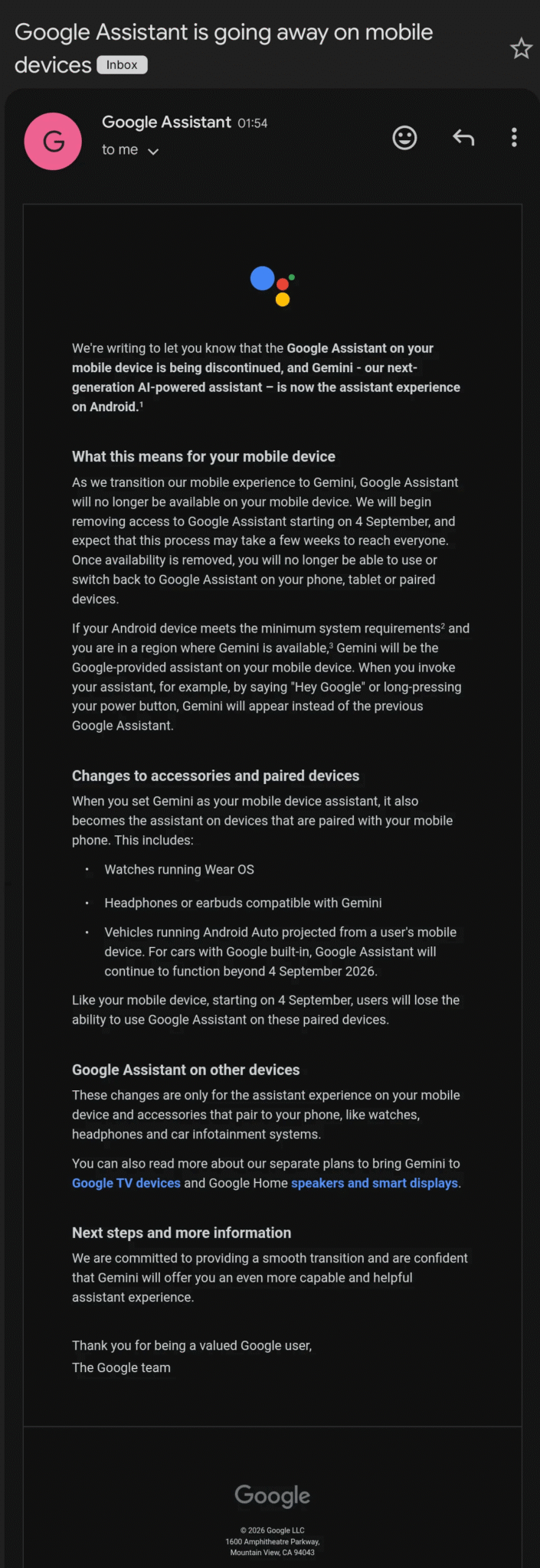
Google Assistant will be officially discontinued on Android and Wear OS devices starting September 4, 2026, marking a significant transition as Google's AI model, Gemini, assumes its functionalities. This announcement confirms previous indications that Gemini would replace the long-standing Google Assistant on mobile platforms. Google communicated this change to some users via email, stating, “As we transition our mobile experience to Gemini, Google Assistant will no longer be available on your mobile device.” The company plans to begin removing access on September 4, with the process expected to take several weeks to complete for all users. Once access is removed, users will be unable to use or revert to Google Assistant on their phones, tablets, or connected devices.
The discontinuation impacts a range of devices beyond just smartphones and tablets. This includes watches running Wear OS, headphones and earbuds compatible with Gemini, and vehicles utilizing Android Auto projected from a user's mobile device. However, for cars equipped with Google's built-in system, Google Assistant is expected to continue functioning beyond the September 4, 2026, deadline. The official date provides clarity for users and developers alike, signaling the end of an era for the familiar voice assistant that has been integrated into the Android ecosystem for years.
This move aligns with broader industry trends toward more sophisticated AI-powered assistants. The transition is particularly noteworthy as it coincides with Apple's own AI advancements. Apple is set to introduce "Apple Intelligence" with iOS 17, which will also be powered by Gemini, replacing the existing Siri. The simultaneous evolution of voice assistants on both major mobile operating systems suggests a significant shift in how users interact with their devices and access information. The long-term implications for search behavior and user engagement are yet to be fully understood, but the increased integration of advanced AI models like Gemini is expected to reshape the digital landscape.
Google Assistant, first launched in 2016, has been a core feature of the Android experience, offering voice commands for tasks such as setting reminders, making calls, sending messages, and controlling smart home devices. Its replacement by Gemini signifies Google's commitment to leveraging its most advanced AI technology across its product suite. Gemini, developed by Google DeepMind, is designed to be a more capable and versatile AI model, able to understand and process various types of information, including text, images, audio, and video. The integration of Gemini into the assistant role is expected to provide users with more natural, context-aware, and powerful interactions, moving beyond simple command-and-control to more complex conversational AI capabilities.
Original source — read the full reporting at the publisher:
Read on Search Engine LandGet the weekly AI digest
AI news + new model releases, weekly. Drafted by our agents, reviewed by humans.