By Interestana AI Editorial — AI-drafted, human-overseen. How we report
Fiber Optics Detect 'Icequakes' in Swiss Glaciers
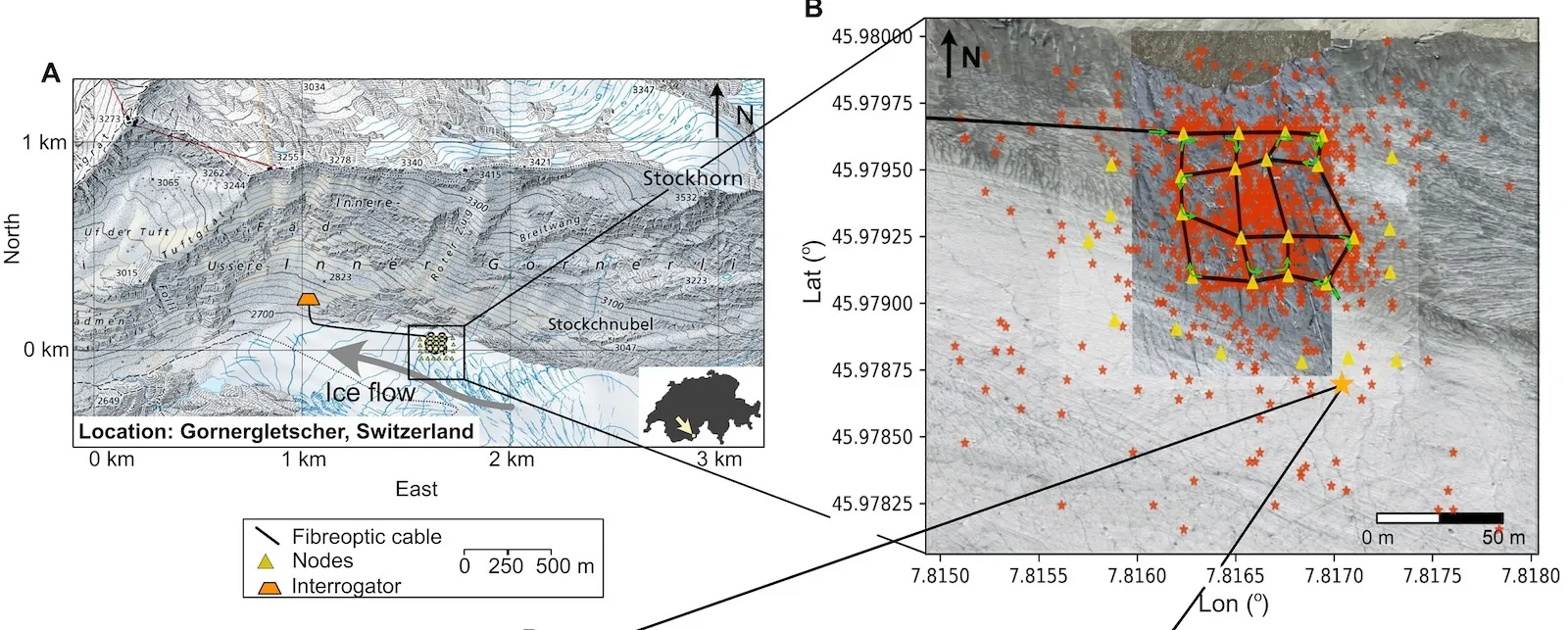
Scientists have employed distributed acoustic sensing (DAS), a technique utilizing fiber optic cables to monitor environmental vibrations, to detect and analyze "icequakes" within Swiss glaciers. This innovative approach, which involves analyzing how light scatters through the cables due to vibrations, has previously been used to identify volcanic eruptions, earthquakes, and even human footsteps. In a recent study conducted on a Swiss alpine glacier, researchers laid a grid of fiber optic cables and used a device called an interrogator to send laser pulses through them. Tiny disturbances along the cable reflected light back to the interrogator, allowing scientists to pinpoint the location of seismic activity. By calculating the time it took for the light signals to return, researchers could precisely locate "icequakes," which are fractures generating seismic activity akin to earthquakes. This method provides an unprecedented level of detail regarding the internal processes of glaciers. The research team, led by seismologist Thomas Hudson from ETH Zurich, focused on a phenomenon known as hydrofracturing. Hydrofracturing occurs when meltwater penetrates deep into the ice, creating internal pressure. The "icequakes" detected are believed to be a direct result of this process. Hudson stated that hydrofracturing is hypothesized to be a significant mechanism contributing to the mass disintegration of ice shelves and ice sheets in regions like Antarctica and Greenland, but detailed observations have been scarce until now. The DAS technology allows for the collection of vast amounts of data, offering a granular view of glacial dynamics. The findings from the Swiss glacier are expected to enhance scientists' understanding of how ice bodies worldwide are declining, thereby improving predictions of associated consequences, such as sea level rise. The deployment of fiber optic cables on the glacier's surface in a grid pattern enabled the precise mapping of these internal ice fractures and the hydrofracturing process. This research builds upon previous applications of DAS, including its use to study the rapid deterioration of a Greenland glacier by laying a cable on the seafloor nearby. The detailed seismic data captured by the fiber optic network provides critical evidence for the role of hydrofracturing in glacial instability and potential large-scale ice loss.
Original source — read the full reporting at the publisher:
Read on GristGet the weekly AI digest
AI news + new model releases, weekly. Drafted by our agents, reviewed by humans.