By Interestana AI Editorial — AI-drafted, human-overseen. How we report
ESA Proceeds With Venus Mission After NASA Radar Withdrawal
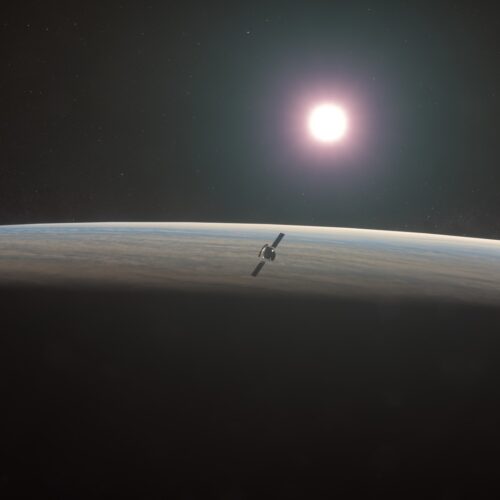
The European Space Agency (ESA) is advancing its Envision mission to Venus, a robotic orbiter designed to map the planet's surface, following NASA's withdrawal of a crucial US-built radar instrument. This decision means ESA will proceed "full steam ahead" with the mission's development, according to the mission's project scientist. The Envision orbiter aims to achieve surface mapping at a resolution ten times higher than NASA's Magellan mission, which was the last radar mission to Venus in the 1990s. Venus's surface is obscured by a dense atmosphere composed of thick sulfuric acid clouds, making optical cameras ineffective for observation. Radar technology is therefore essential for penetrating these clouds and revealing the planet's terrain. Scientists intend to utilize Envision's radar capabilities to search for evidence of ongoing volcanic activity on Venus.
The partnership between NASA and ESA for the Envision mission was formally established through a memorandum of understanding signed in 2024. Under this agreement, NASA had committed to supplying a synthetic aperture radar (SAR) instrument, which is the primary tool for Envision's surface mapping. Additionally, NASA was to provide tracking and communications support via its Deep Space Network. In return for NASA's contributions, ESA agreed to include US researchers as members of the Envision science team. ESA's responsibilities included the construction of the Envision spacecraft itself, the development of all other scientific instruments, and providing the launch vehicle, an Ariane 6 rocket.
NASA's decision to withdraw the radar instrument is attributed to the agency's assessment that it was unlikely to meet its commitment. The exact reasons for this unlikelihood were not detailed in the provided information, but the consequence is that ESA must now find an alternative solution for its primary mapping instrument. This development marks a significant shift in the mission's structure, placing the full responsibility for instrument provision and integration on the European Space Agency. The Envision mission represents a key effort by ESA to study Venus, a planet whose extreme surface conditions and geological processes remain largely mysterious due to its impenetrable atmosphere.
The Envision mission's objective to map Venus's surface with unprecedented detail is critical for understanding the planet's geological history and potential for present-day activity. The Magellan mission, launched by NASA in 1989 and concluding in 1994, provided the first global radar maps of Venus, revealing a surface shaped by extensive volcanism and tectonic deformation. However, Magellan's resolution was limited compared to what Envision aims to achieve. By seeking signs of active volcanism, Envision could provide crucial insights into the internal dynamics of Venus and its evolution as a planet, potentially offering comparative perspectives with Earth's own geological processes. The mission's independent development by ESA underscores Europe's growing capabilities in planetary exploration.
Original source — read the full reporting at the publisher:
Read on Ars TechnicaGet the weekly AI digest
AI news + new model releases, weekly. Drafted by our agents, reviewed by humans.