By Interestana AI Editorial — AI-drafted, human-overseen. How we report
Ethereum Sepolia Testnet Near 200 Million Gas Per Block
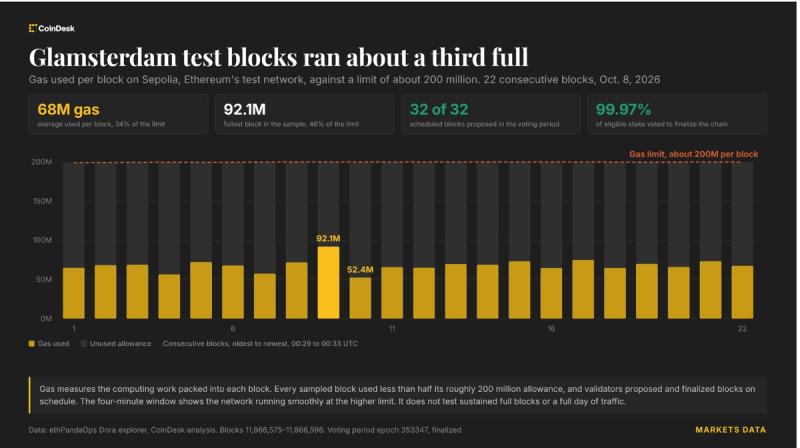
Ethereum's Sepolia testnet has successfully conducted rehearsal runs that pushed its processing capacity to nearly 200 million gas per block, marking a substantial increase in its transaction handling capabilities. This significant boost in the gas limit, a metric representing the computational effort required to execute operations on the Ethereum network, was a key outcome of a recent upgrade implemented on the testnet. The Sepolia testnet, a crucial environment for developers to test decentralized applications and protocol changes before deploying them on the main Ethereum network, saw its processing budget more than triple as a direct result of this upgrade. The objective of increasing the gas limit is to accommodate a higher volume of transactions and more complex smart contract executions, thereby enhancing the network's scalability and efficiency. During these rehearsal runs, sampled blocks, which represent individual batches of transactions processed by the network, utilized less than half of the newly available gas allowance. This indicates that while the network's capacity has been significantly expanded, current transaction loads on the testnet do not yet demand the full extent of this increased limit. The upgrade, aimed at preparing the network for future scaling solutions, is a critical step in Ethereum's ongoing development roadmap, often referred to as 'The Surge,' which focuses on improving the network's throughput and reducing transaction costs. The increase in gas limit on Sepolia is a precursor to potential similar adjustments on the mainnet, contingent on further testing and network stability assessments. Developers are closely monitoring these test runs to understand the implications for gas fees, transaction finality, and the overall user experience of decentralized applications. The Sepolia testnet has been instrumental in validating numerous Ethereum Improvement Proposals (EIPs) and protocol upgrades, providing a realistic simulation environment. This latest test, by pushing the gas limit to such a high threshold, allows for the evaluation of network performance under simulated high-demand conditions, identifying potential bottlenecks or issues that might arise with increased activity. The successful execution of these tests signifies progress towards a more scalable and robust Ethereum ecosystem, which is vital for the widespread adoption of decentralized technologies. The ability to process more transactions per block is fundamental to supporting a growing number of users and applications on the blockchain. This development is part of Ethereum's broader strategy to transition from its current proof-of-work consensus mechanism to a more energy-efficient proof-of-stake model, and subsequently implement sharding and other layer-2 scaling solutions. The increased gas limit on Sepolia is a tangible step in this direction, demonstrating the network's evolving capacity to handle a larger and more diverse set of operations.
Original source — read the full reporting at the publisher:
Read on CoinDeskGet the weekly AI digest
AI news + new model releases, weekly. Drafted by our agents, reviewed by humans.