By Interestana AI Editorial — AI-drafted, human-overseen. How we report
AI Focuses on Email Content, Ignores Revenue Drivers
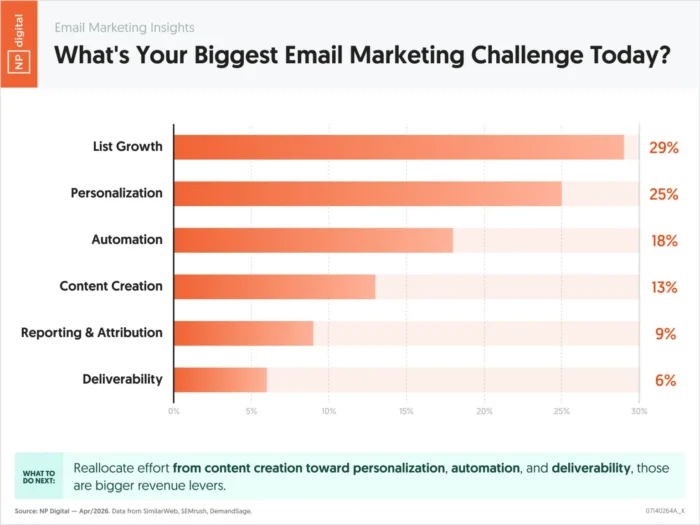
AI adoption in email marketing is heavily concentrated on content production, with a significant portion of marketing teams directing their AI efforts towards generating more emails rather than addressing core revenue-driving aspects of their programs. This focus overlooks personalization, automation, and deliverability, which are identified as the key areas for substantial revenue gains. While 29 percent of marketers cite list growth as their biggest email challenge, followed by personalization at 25 percent, deliverability is ranked last by only 6 percent, despite its critical impact on engagement and revenue.
Personalization in email marketing is evolving beyond broad segmentation, such as demographics and geography, to embrace individual, predictive targeting. This shift aims to understand customer intent more deeply and deliver highly relevant experiences at scale. Automation's contribution to email revenue correlates strongly with company size. Businesses with revenues exceeding $51 million generate 71 percent of their email revenue from automation, in stark contrast to the 11 percent derived from traditional campaigns. This highlights a significant opportunity for larger organizations to leverage automation for greater efficiency and impact.
Deliverability, the ability of emails to reach subscriber inboxes, is a critical but often neglected component. Nearly one-fifth of all sent emails fail to reach their intended destination, with most of these losses occurring before a subscriber even has an opportunity to engage with the content. This represents a substantial leakage of potential engagement and revenue. The most successful email programs integrate personalization, automation, and deliverability into a cohesive, self-reinforcing system. This integrated approach ensures that efforts in one area complement and enhance the others, leading to more effective and profitable email marketing campaigns.
Marketers are currently facing intense pressure to achieve more with fewer resources, scale personalization efforts, enhance customer retention and lifetime value, and boost overall marketing efficiency. Artificial intelligence is perceived as a potential solution to these challenges, but its application is often misdirected. The core issue is that AI is frequently used to increase email volume without adequately addressing the underlying mechanisms that truly drive revenue. The real opportunity lies in understanding customer intent, automating decision-making processes, and delivering personalized experiences at an unprecedented scale. By focusing AI on content creation alone, marketers are missing the chance to optimize the critical elements of personalization, automation, and deliverability that are essential for moving the revenue needle.
Original source — read the full reporting at the publisher:
Read on Neil PatelGet the weekly AI digest
AI news + new model releases, weekly. Drafted by our agents, reviewed by humans.