Dragonflies Use Fighter Pilot Tactics in Territory Defense
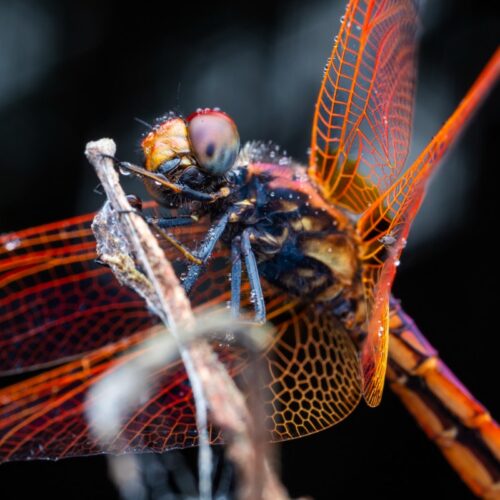
Male dragonflies engage in mid-air "dogfights" to defend their breeding territories, employing distinct maneuvers compared to those used when hunting prey. A new study published in the Journal of the Royal Society Interface indicates that these territorial defense behaviors are driven by relatively simple rules focused on maintaining a tactical position, a strategy that mirrors human fighter pilot tactics. This research holds potential for developing more intelligent drones capable of vision-based guidance with less reliance on complex computational systems.
Unlike typical pursuit scenarios involving prey or mating, where interactions are asymmetric with a clear chaser and evader, male-on-male territorial disputes involve mutual pursuit. The researchers hypothesized that studying the flight trajectories of insects or raptors could offer insights into the underlying guidance laws governing such behaviors. They selected the Trithemis Aurora dragonfly species for their study due to the males' fiercely territorial nature and the species' crimson coloration, which aids in tracking.
Previous research on dragonfly interactions often relied on visual observations or single-camera recordings. This study, however, utilized a portable stereovideographic rig equipped with two shutter-synchronized cameras. This setup allowed for the recording of dragonfly interactions in both color and monochrome, enabling the reconstruction of 102 paired male-on-male flight trajectories to capture their three-dimensional kinematics. For comparative analysis, the researchers also reconstructed nine trajectories of dragonflies intercepting prey. These detailed kinematic reconstructions facilitated the development of a model outlining the rules that govern the dragonflies' flight behavior during territorial disputes.
Original source — read the full reporting at the publisher:
Read on Ars Technica