By Interestana AI Editorial — AI-drafted, human-overseen. How we report
Bond Volatility Spikes; Bitcoin, Wall Street Remain Stable
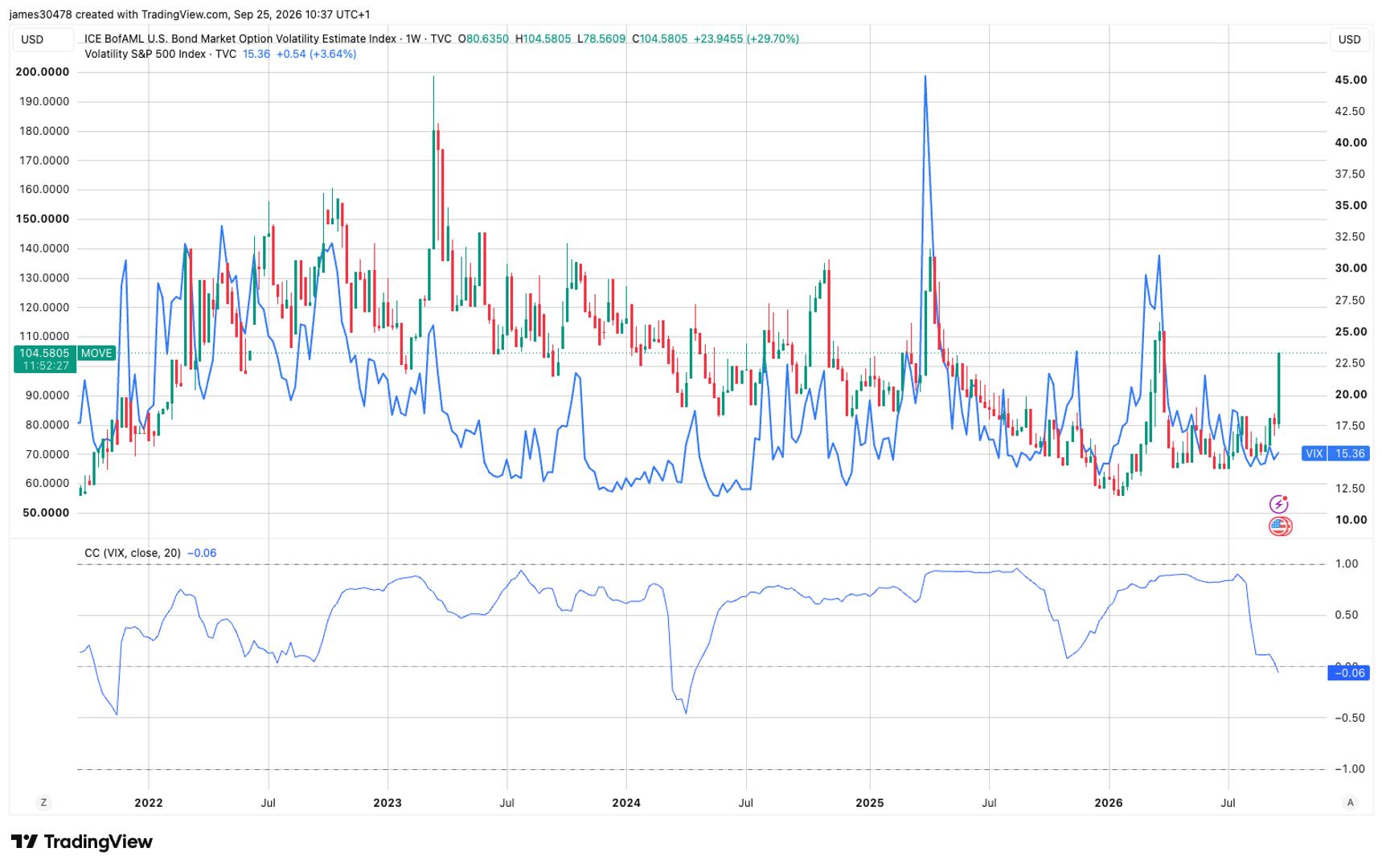
Bond market volatility has surged to its highest level since March, indicating a period of significant price fluctuation within fixed-income securities. This sharp increase in volatility, often measured by indices like the MOVE index, suggests heightened uncertainty among investors regarding future interest rate movements and economic conditions. The MOVE index, which tracks expected volatility in U.S. Treasury yields, has recently climbed, reflecting a growing nervousness about inflation, central bank policy, and geopolitical events that could impact the bond market.
In stark contrast to the turbulence in bonds, both the cryptocurrency market, specifically Bitcoin, and the traditional U.S. stock market have maintained a notable degree of stability. The Bitcoin Volatility Index (BVIV), which measures expected price swings in Bitcoin, remains near its yearly low. This suggests that investors in Bitcoin are not anticipating significant price dislocations in the near future, despite the broader market's unease. Similarly, the Cboe Volatility Index (VIX), often referred to as Wall Street's "fear gauge," is also hovering near its yearly low. The VIX measures the market's expectation of 30-day forward-looking volatility of the S&P 500 index. A low VIX typically signifies investor complacency and a belief that the stock market is unlikely to experience sharp downturns.
The divergence in volatility between the bond market and both Bitcoin and equities presents an interesting market dynamic. Historically, periods of high bond market volatility can sometimes spill over into other asset classes as investors reallocate capital in response to changing risk perceptions. However, in this instance, the stability in Bitcoin and the S&P 500 suggests that either the factors driving bond volatility are perceived as contained within that specific market, or that investors are treating these asset classes as distinct hedges or safe havens. The resilience of Bitcoin and the S&P 500 could be attributed to various factors, including strong corporate earnings in the equity market, ongoing institutional adoption and development in the cryptocurrency space, or a general belief that current economic conditions, while uncertain, do not warrant a broad-based sell-off across all asset classes. This scenario highlights the complex interplay of market forces and investor sentiment, where different asset classes can react independently to a shared economic backdrop.
Original source — read the full reporting at the publisher:
Read on CoinDeskGet the weekly AI digest
AI news + new model releases, weekly. Drafted by our agents, reviewed by humans.