By Interestana AI Editorial — AI-drafted, human-overseen. How we report
Bitcoin Sensitivity to Treasury Yields Less Than Gold
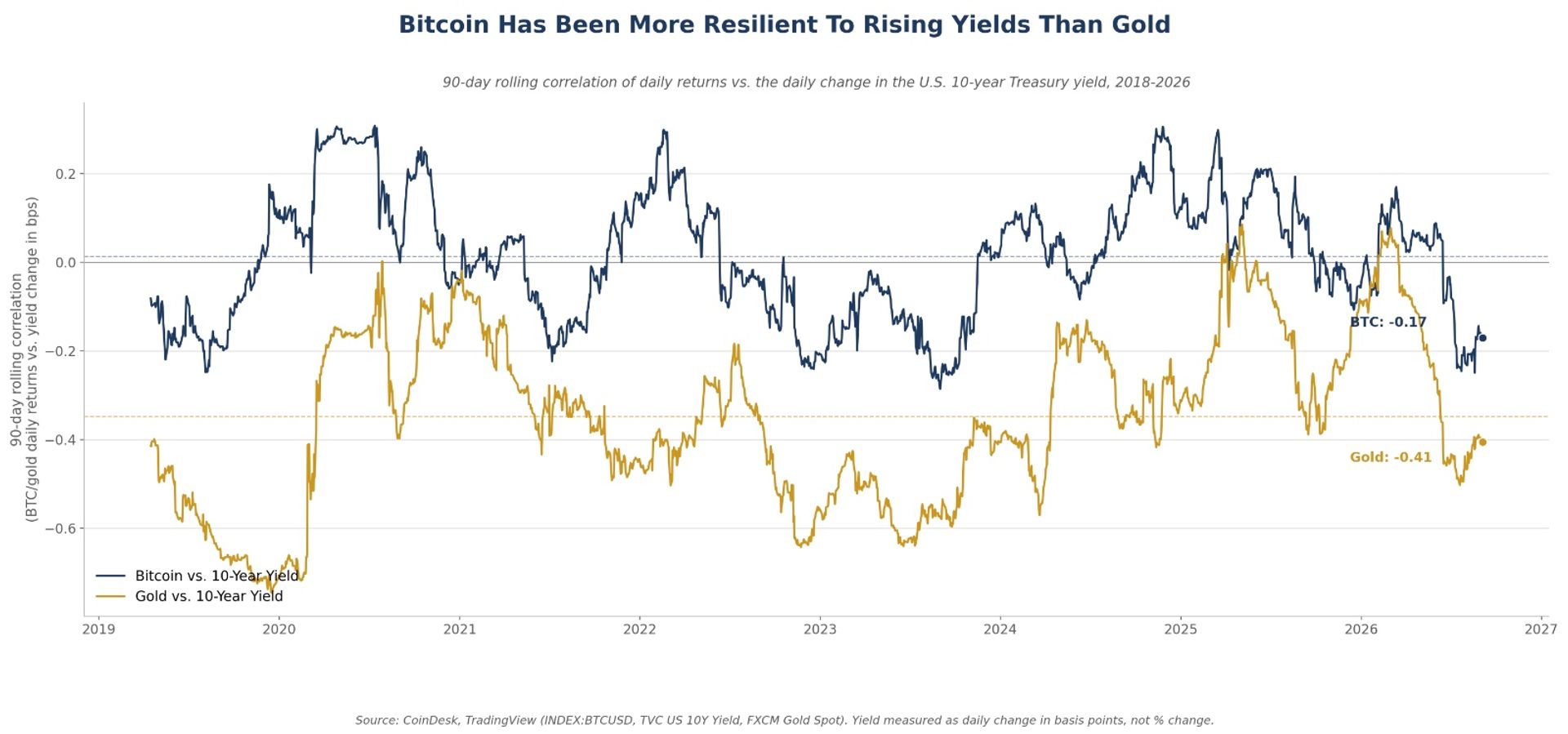
Bitcoin's correlation with US Treasury yields has decreased significantly, indicating a reduced sensitivity to interest rate fluctuations compared to gold. This shift suggests that Bitcoin may be maturing as an asset class, potentially becoming less of a speculative risk-on asset and more of a store of value, similar to gold. Historically, both Bitcoin and gold have been viewed as inflation hedges and safe-haven assets, but their responses to macroeconomic shifts, particularly changes in Treasury yields, have varied. Treasury yields, which represent the return on government debt, are a key indicator of borrowing costs and inflation expectations. When yields rise, it typically makes holding cash or fixed-income assets more attractive, potentially drawing investment away from riskier assets like cryptocurrencies and commodities. Conversely, falling yields can make these riskier assets more appealing.
Recent analysis, as of September 7, 2026, shows that Bitcoin's price movements have become less synchronized with movements in US Treasury yields. This divergence is notable because, in the past, periods of rising Treasury yields often coincided with declines in Bitcoin's price, and vice versa. This pattern suggested that investors were treating Bitcoin as a risk asset highly sensitive to monetary policy shifts. The current decoupling implies that other factors may be exerting a stronger influence on Bitcoin's price, or that its role in investor portfolios is evolving. This could include increasing institutional adoption, regulatory clarity, or its perceived role as a digital store of value independent of traditional financial market dynamics.
Gold, on the other hand, has historically maintained a more consistent, albeit complex, relationship with Treasury yields. While gold prices can also be affected by rising yields (as they increase the opportunity cost of holding a non-yielding asset), its status as a traditional safe haven often allows it to retain value or even appreciate during times of economic uncertainty, regardless of yield movements. The observation that Bitcoin is now exhibiting less sensitivity than gold to these yield changes is a significant development. It suggests that Bitcoin might be carving out a distinct niche in the investment landscape, potentially appealing to investors seeking diversification beyond traditional assets and inflation hedges that are less tethered to the immediate impacts of central bank policy on borrowing costs.
This evolving correlation could have implications for how investors allocate capital. If Bitcoin is indeed becoming less reactive to interest rate environments, it might be considered a more stable component of a diversified portfolio. However, it is crucial to note that the cryptocurrency market remains dynamic and subject to various influences, including technological developments, regulatory news, and broader market sentiment. The long-term implications of this reduced correlation will likely become clearer as more data emerges and as Bitcoin continues to integrate further into the global financial system. The current trend, however, points towards a potential maturation of Bitcoin as an asset class, moving beyond its initial perception as a purely speculative digital token.
Original source — read the full reporting at the publisher:
Read on CoinDeskGet the weekly AI digest
AI news + new model releases, weekly. Drafted by our agents, reviewed by humans.