By Interestana AI Editorial — AI-drafted, human-overseen. How we report
Attribution and Incrementality Measure Different Marketing Questions
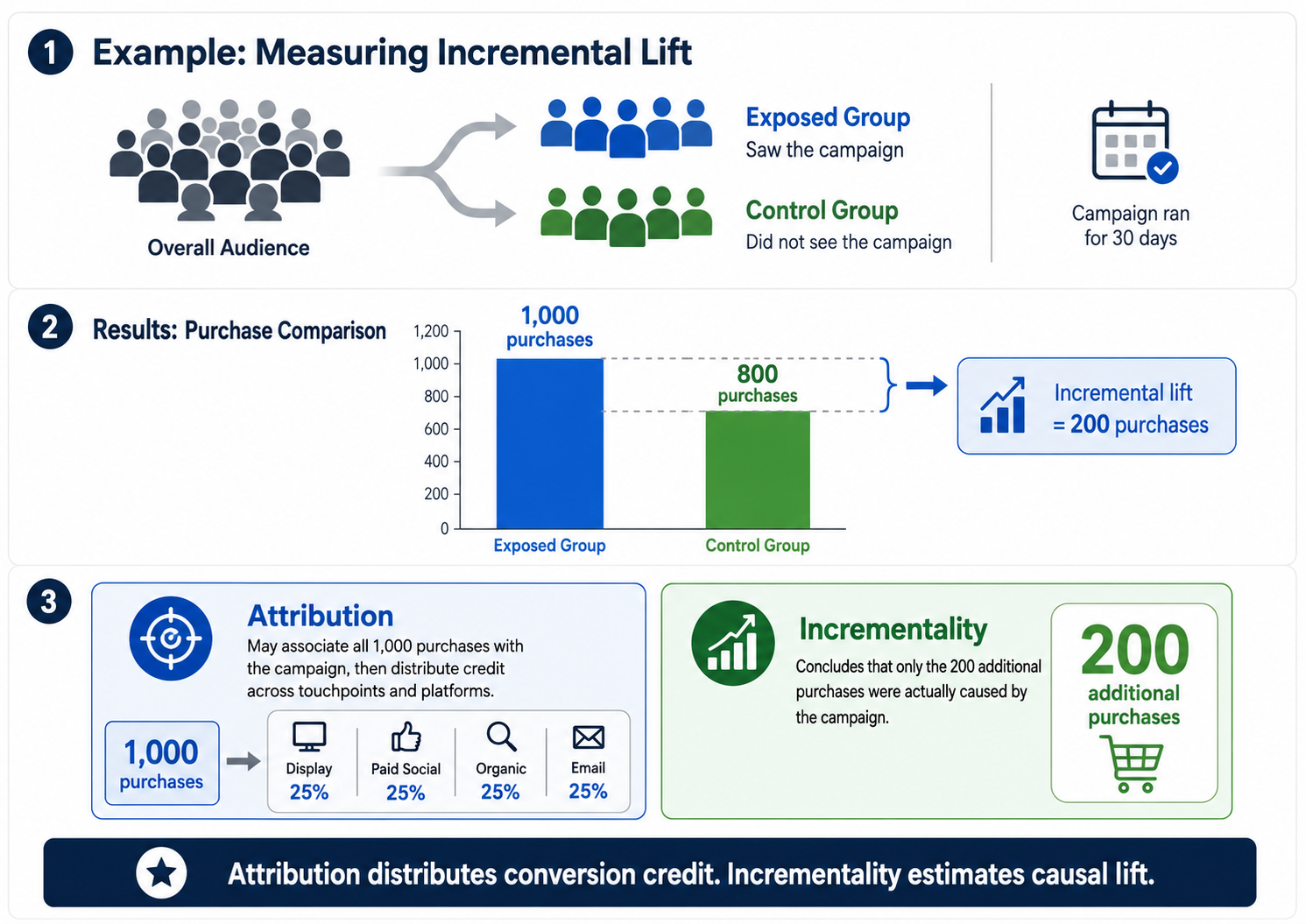
Attribution and incrementality represent distinct methodologies for evaluating marketing performance, often mistakenly perceived as competing perspectives on the same data. In reality, they are designed to address fundamentally different inquiries by employing varied forms of evidence. Attribution focuses on determining which observed marketing touchpoints should be credited for a conversion. Conversely, incrementality seeks to ascertain whether marketing activities generated additional conversions that would not have occurred in their absence.
Attribution modeling gained prominence around 2015 as marketers grappled with complex conversion paths involving multiple touchpoints across the digital landscape. A typical scenario might involve a user journey such as Display advertisement → Paid Social media → Organic Search → Email marketing → Purchase. This complexity raised critical questions about the equitable distribution of credit among these various channels. Should the initial display ad receive the most credit due to being the first point of contact? Or should the final email touchpoint, which directly led to the purchase, be prioritized? The intermediate touchpoints, like the paid social ad and organic search presence, also posed challenges for credit allocation. Attribution modeling emerged as a solution, providing frameworks to distribute conversion credit. Some models assign the entire conversion value to a single touchpoint, while others divide it among multiple interactions. For instance, if a conversion is valued at $100, an attribution model might allocate $30 to the display ad, $30 to the email campaign, and distribute the remaining $40 between paid social and organic search efforts. This nuanced approach enables marketers to evaluate channel success more effectively and inform budget allocation decisions for future fiscal periods by offering a comparative framework for revenue credit distribution.
Incrementality, on the other hand, moves beyond assigning credit to observed touchpoints and instead focuses on causal inference. It aims to answer the question: "What would have happened if this marketing activity had not occurred?" This is typically measured through controlled experiments, such as A/B tests or lift studies. In a lift study, a control group is exposed to no marketing, while a test group receives the marketing campaign. By comparing the conversion rates between the two groups, marketers can quantify the incremental lift – the number of additional conversions directly attributable to the marketing campaign. For example, if a paid search campaign results in 1,000 conversions in the test group and only 700 in the control group, the incremental lift is 300 conversions. This incremental value represents the true return on investment (ROI) of the marketing activity, as it accounts for conversions that would have happened organically or through other means. Understanding incrementality is crucial for optimizing marketing spend, as it helps identify campaigns that are truly driving new business rather than simply capturing existing demand or influencing conversions that would have occurred anyway. While attribution provides a valuable understanding of customer journeys and channel influence, incrementality offers a more direct measure of marketing's impact on business growth.
Original source — read the full reporting at the publisher:
Read on Search Engine LandGet the weekly AI digest
AI news + new model releases, weekly. Drafted by our agents, reviewed by humans.