Artificial Cell Achieves Limited Cell Division
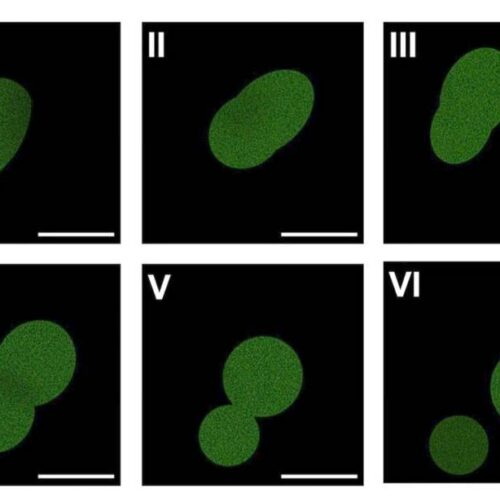
Researchers at the University of Minnesota have developed a simplified artificial cell system that can manage a few rounds of cell division. This breakthrough addresses a key question in understanding the origin of life: how membranes came to surround early cells. While membranes can spontaneously form and enclose substances, they typically isolate their contents, halting essential chemical reactions due to a lack of raw materials.
The new system overcomes this limitation by enabling the artificial cell's membrane to continuously import new materials from its external environment. This continuous supply of resources allows the enclosed genetic material to sustain activity and facilitates the cell's spontaneous division. The researchers successfully observed the system producing a few generations of "offspring" before its functionality began to decline.
Although the artificial cell remains highly dependent on human intervention for its operation, it represents a significant step forward in exploring the origins of life. This model provides a new avenue for investigating how minimalistic forms of life might have emerged and functioned on early Earth. The work contributes to understanding the complex interplay between simple chemicals, genetic molecules, and the formation of cellular structures.
Original source — read the full reporting at the publisher:
Read on Ars Technica