By Interestana AI Editorial — AI-drafted, human-overseen. How we report
Researchers Entangle Glass Bead and Light Beam
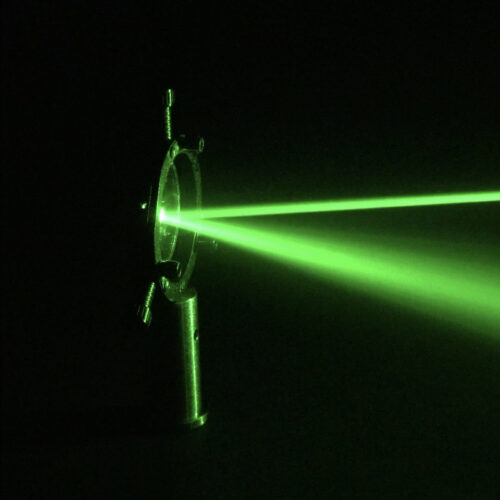
Researchers have achieved a significant breakthrough by successfully entangling a macroscopic glass bead with a beam of light, demonstrating quantum correlations at a larger scale. This experimental feat pushes the boundaries of quantum mechanics, traditionally observed at the subatomic level, into the realm of everyday objects. Quantum entanglement, a phenomenon where two or more particles become linked and share the same fate regardless of the distance separating them, has been a subject of fascination and study for decades. While often described using evocative but potentially misleading terms like "spooky action at a distance," entanglement is a fundamental aspect of quantum theory that describes correlated behaviors between quantum systems.
The experiment involved linking the quantum state of a tiny glass bead, approximately 50 micrometers in diameter, with the quantum state of a light beam. This means that the properties of the bead and the light became interdependent. Measuring a property of one instantaneously influences the corresponding property of the other, even if they are physically separated. This is a departure from classical physics, where objects have independent properties and interactions are limited by the speed of light. The researchers' success in entangling a macroscopic object like a glass bead with light is notable because it challenges the intuitive notion that quantum effects are confined to the microscopic world of atoms and subatomic particles. It suggests that quantum phenomena can persist and be observed in larger, more complex systems than previously thought possible.
This achievement is a testament to advancements in experimental techniques and our understanding of quantum mechanics. It opens new avenues for research in quantum computing, quantum communication, and fundamental physics. For instance, the ability to control and manipulate quantum states of larger objects could lead to more robust quantum sensors or novel methods for transferring quantum information. The experiment also provides a platform for further exploring the transition from quantum to classical behavior, a key question in physics known as the quantum-to-classical transition. By demonstrating entanglement with a bead of this size, scientists are probing the limits of quantum coherence and the conditions under which quantum effects remain observable.
While the specifics of the experimental setup and the precise nature of the correlations achieved are detailed in the full research paper, the core accomplishment lies in establishing a verifiable quantum link between a tangible, macroscopic object and a beam of light. This experimental tour-de-force moves beyond theoretical discussions and provides empirical evidence for quantum phenomena operating at an unprecedented scale. The implications for future technological development and our fundamental understanding of the universe are substantial, marking a pivotal moment in the ongoing exploration of quantum mechanics.
Original source — read the full reporting at the publisher:
Read on Ars TechnicaGet the weekly AI digest
AI news + new model releases, weekly. Drafted by our agents, reviewed by humans.