By Interestana AI Editorial — AI-drafted, human-overseen. How we report
US Happiness Declines Sharply Post-2020
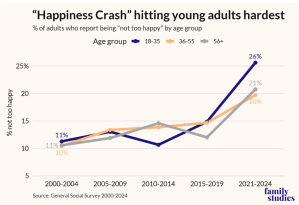
American happiness levels have experienced an unprecedented decline since 2020, according to economist Sam Peltzman of the University of Chicago’s Booth School of Business. For nearly five decades, from 1972 to 2018, the General Social Survey consistently showed a stable balance in reported happiness among Americans. However, the onset of the COVID-19 pandemic triggered a sharp downturn. Peltzman described this change as "a huge change," noting that while happiness has shown some rebound, it has not returned to pre-pandemic levels. He quantified the net change as a "minus 20," which he stated is "utterly unprecedented." The initial drop in 2020 was 25 points, with only a 5-point recovery since then. To contextualize this decline, Peltzman compared it to the Great Recession, a previous major shock to American society, which resulted in a maximum happiness drop of only 10 points and a swift recovery. Contrary to initial assumptions that economic pressures like rising grocery and gas prices were the primary drivers of this unhappiness, Peltzman's analysis indicates that the affordability crisis is not the sole or even primary cause, particularly for the demographic experiencing the most significant happiness crash. His data reveals that the individuals who fell furthest in happiness after 2020 were those who had the most advantages prior to the pandemic: white, high-income, college-educated, and right-leaning Americans. Peltzman explicitly stated that "the affordability business is not an upper-income kind of concern. It’s a lower-income kind of concern, and the upper-income people have been hit hardest in the happiness crash." He further debunked theories attributing the decline to inequality, asserting that "Any story which says that it’s inequality, those kind of stories are not consistent with the facts." Peltzman's research highlights a significant divergence in happiness based on marital status, suggesting a "happiness-segregated society by marriage." Married individuals, on average, continue to report a net positive level of happiness. In contrast, unmarried Americans, who constitute approximately 45% of the adult population, are now, on net, unhappy. "The only people who are positive, where there’s a clear positive balance in happiness, are married people," Peltzman stated. This observation points to marriage as a key factor differentiating happiness levels in the current American landscape. The data suggests that while the overall happiness of the nation has diminished, married individuals represent a demographic that has largely maintained or retained its positive emotional state, standing in stark contrast to their unmarried counterparts.
Original source — read the full reporting at the publisher:
Read on FortuneGet the weekly AI digest
AI news + new model releases, weekly. Drafted by our agents, reviewed by humans.