By Interestana AI Editorial — AI-drafted, human-overseen. How we report
Amazon Workers on Food Stamps Triple Amid Record Revenue
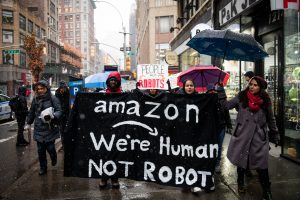
The U.S. workforce is experiencing a historic decline in its share of economic output, with workers now receiving 52.8% of economic output, the lowest percentage recorded by the Bureau of Labor Statistics since 1947. This shrinking "labor share" of wealth, distributed through wages, contrasts sharply with exploding corporate profits. The S&P 500 index has seen a 600% gain since the year 2000, while inflation-adjusted wages have increased by only 12.5% over the same period, indicating a widening gap between corporate earnings and worker compensation. This economic trend is manifesting in tangible consequences for employees, even at large, profitable companies.
A recent Government Accountability Office (GAO) report examined 11 sampled states and found that Amazon, the nation's largest company by revenue, had 12,346 workers enrolled in the Supplemental Nutrition Assistance Program (SNAP), commonly known as food stamps, and 11,338 relying on Medicaid. This represents a near tripling of Amazon employees requiring federal assistance compared to a similar GAO report conducted in 2020. During this same timeframe, Amazon's annual profits surged dramatically, from $11.6 billion to $77.7 billion. Further underscoring the company's financial performance, Amazon's revenue for 2025 reached a record $717 billion, marking a 12% year-over-year increase from $638 billion.
In response to the GAO report's findings, Amazon spokesperson Rachael Lighty stated that the conclusions drawn are "wrong" and misleading when raw numbers are considered without context. Lighty emphasized that Amazon's pay is competitive within the industry and that regular full-time employees receive comprehensive health care benefits from their first day of employment. These benefits are available for a nominal fee of $5 per week for employee-only coverage, with $5 copays. According to Lighty, 74% of Amazon's regular full-time employees are enrolled in the company's health insurance plan, a figure that significantly exceeds the 65% private-sector take-up rate for full-time workers. Lighty challenged other large retailers to offer similar "Day 1" comprehensive healthcare benefits.
The broader economic context reveals that the shrinking labor share is not isolated to Amazon but is a systemic issue. The decline in labor's slice of the economic pie means that a smaller proportion of the wealth generated by businesses is being distributed to the workforce through wages. This phenomenon is often attributed to factors such as increased automation, globalization, and shifts in corporate bargaining power. As corporate profits continue to rise, the disparity between executive compensation and average worker earnings widens, leading to increased reliance on public assistance programs for low-wage workers, even within highly profitable corporations. The GAO report's findings for Amazon serve as a stark illustration of this broader economic trend, prompting discussions about wage stagnation, corporate responsibility, and the effectiveness of social safety nets in an era of unprecedented corporate profitability.
Original source — read the full reporting at the publisher:
Read on FortuneGet the weekly AI digest
AI news + new model releases, weekly. Drafted by our agents, reviewed by humans.