Alphabet Powers 44% Jump in India Foreign Investment, UN Says
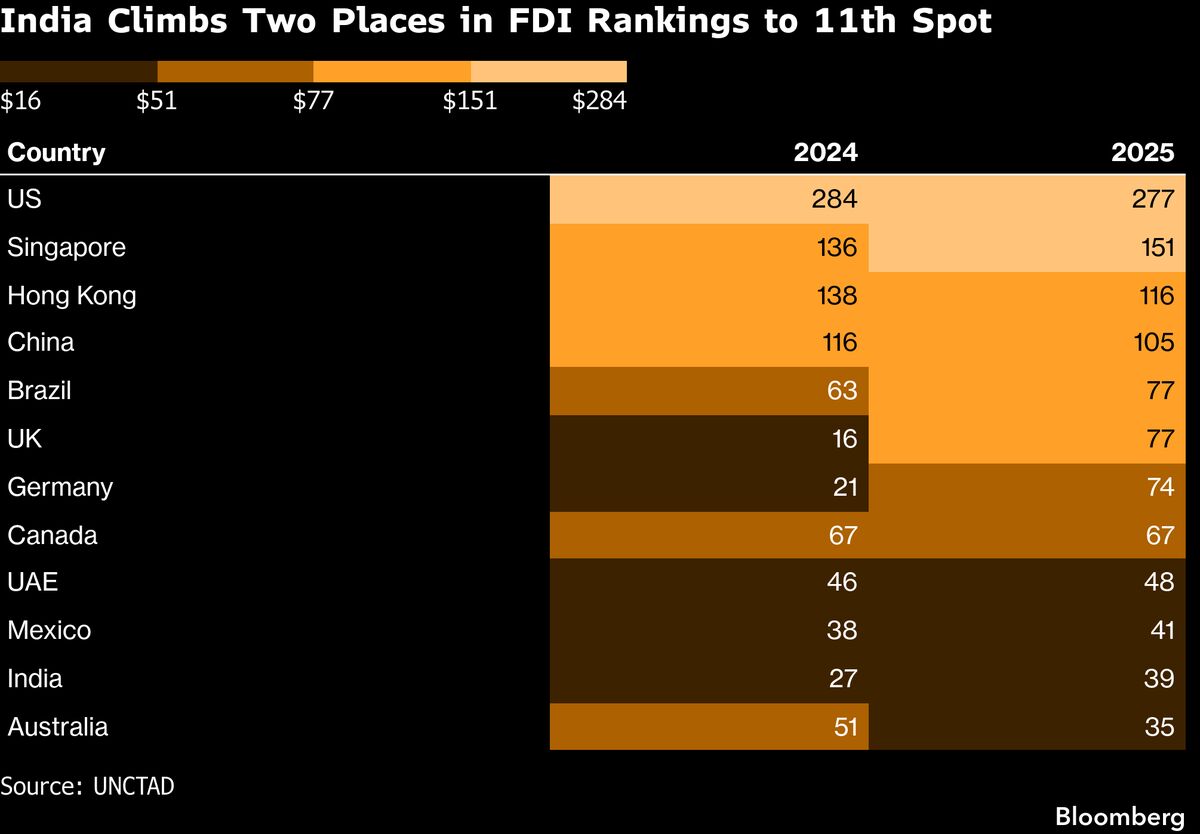
Foreign direct investment (FDI) in India experienced a substantial 44% increase in 2025, largely propelled by a significant investment from Alphabet Inc. for its data center project. This surge contributed to a total FDI inflow of $70.9 billion for the fiscal year ending March 2025, a notable rise from $49.3 billion in the previous fiscal year. The United Nations Conference on Trade and Development (UNCTAD) highlighted this growth in its World Investment Report 2024, released on June 13, 2024.
Despite the overall increase in FDI, the report also pointed to a concerning trend: a decline in greenfield investments. Greenfield investments, which involve establishing new facilities, fell by 14% to $22.7 billion in fiscal year 2025. This decrease in new project announcements suggests a potentially weaker outlook for future investment in the country, even as mergers and acquisitions (M&A) saw a significant uptick. M&A deals, including cross-border transactions, more than doubled to $48.2 billion in the same period, indicating a shift towards consolidation and acquisition rather than new capacity building.
The UNCTAD report, citing data from India's Department for Promotion of Industry and Internal Trade (DPIIT), attributed the strong performance in M&A to factors such as the privatization of public sector undertakings and increased investor interest in sectors like telecommunications and energy. The substantial contribution from Alphabet's data center project, valued at $1.5 billion, underscores the impact of large-scale foreign investments on national FDI figures. However, the dip in greenfield investments warrants attention from policymakers aiming to foster sustained economic expansion and job creation through new industrial ventures.
This mixed performance in India's investment landscape presents a complex picture for economic analysts. While the headline FDI figures show robust growth, the underlying composition of this investment, with a decline in new project establishments, signals potential challenges ahead. The UNCTAD's analysis provides a critical overview of these trends, emphasizing the need for strategies that encourage both large-scale projects and the development of new enterprises to ensure long-term economic vitality.
Original source — read the full reporting at the publisher:
Read on Bloomberg Markets